Wider Lens sat down with DGC Ontario Director Member Christopher Yip to talk about his roots in Edmonton’s Chinese Christian community, what inspired his pivot to film, his hopes and dreams for Canada’s indie filmmakers, and why he’s drawn to telling deeply personal stories through the power of cinema.
“That’s what interests me, the moral gray. When you’re younger, everything feels black and white. But change is possible, even when it doesn’t seem like it. I’m grateful I can work out those feelings through film. It’s like therapy.”
– Director Christopher Yip
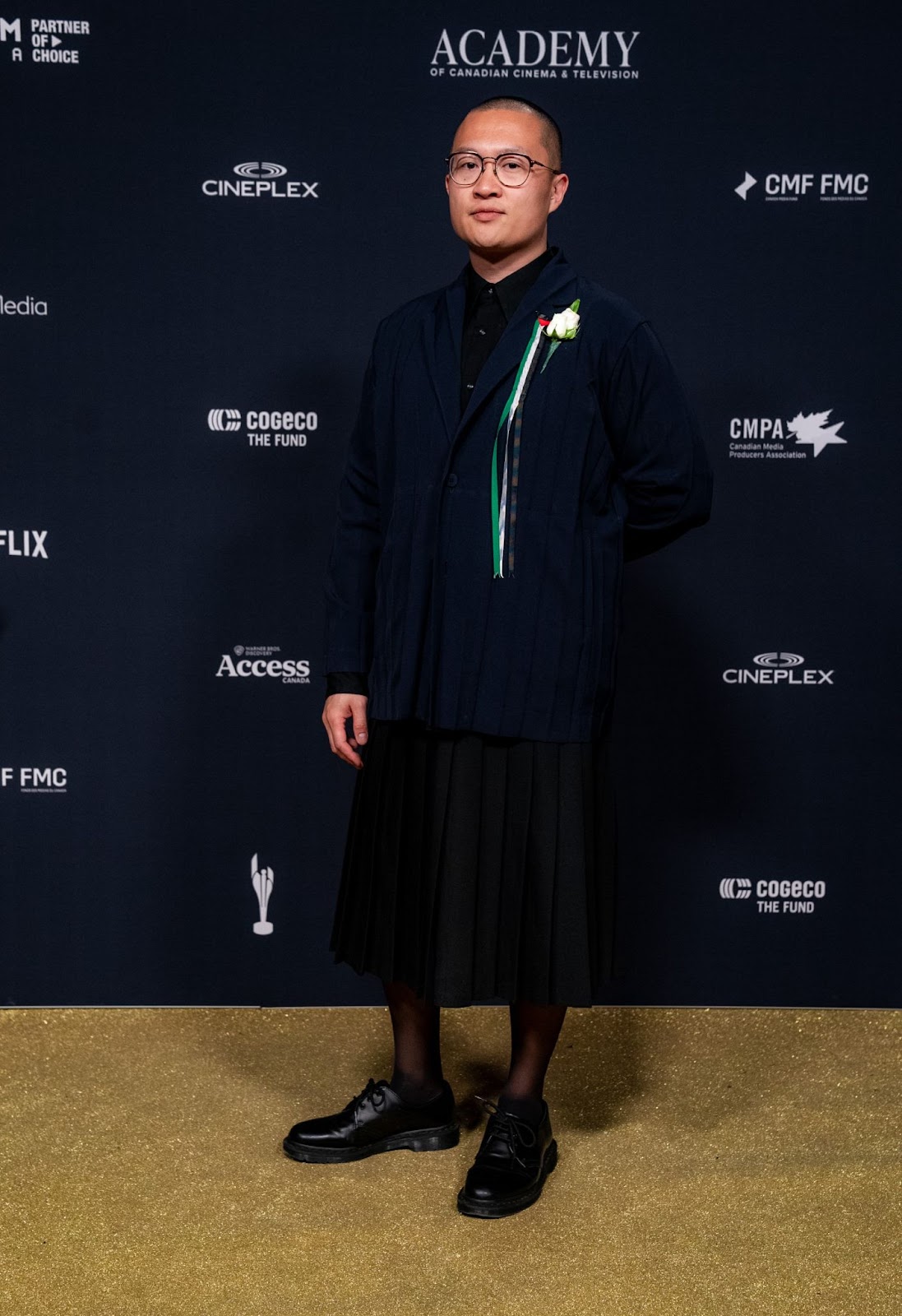
Director Christopher Yip at the 2024 Canadian Screen Awards. His series Streams Flow From a River won the Canadian Screen Award in 2024 for Best Direction, Web Program or Series.
Can you start by telling me a little bit about your background, as a person and as a filmmaker?
Christopher Yip: I was born and raised in Edmonton to immigrants from Hong Kong. My parents moved there in the ’70s and had us in the late ’80s and early ’90s. I have two younger brothers, and we grew up in a small Chinese Christian bubble. Edmonton is also very white, so I definitely felt like I didn’t belong. That outsider perspective informs a lot of the stories I want to tell, very much through observation, looking at the little, weird things people do and how we behave.
I grew up loving movies. For some reason, my parents let me watch Jurassic Park when I was four. I watched it three times a day! I just loved dinosaurs. I also watched The Land Before Time constantly. But I never thought film was a real job. In university, I’d hand in videos instead of essays when I could, just little projects with my classmates for fun.
A big turning point came in high school. I kept making short video projects, and my teacher, Mr. Castrinos, said, “You really have a knack for this.” He didn’t even know about the industry, but that encouragement meant a lot. At that time, I still wanted to be a pastor. I grew up very Christian, and I thought that was my path. But when that didn’t work out, I went through a big crisis of faith. I ended up moving to Japan to teach English and figure things out. That’s when I asked myself: “Why don’t I just go for it?”
Watching Moonlight was huge for me. Masculinity deconstructed through a racialized lens – that was everything. That’s when I started writing Fish Boy, my first short. Soon after, I decided to move to Toronto and give film a real shot.
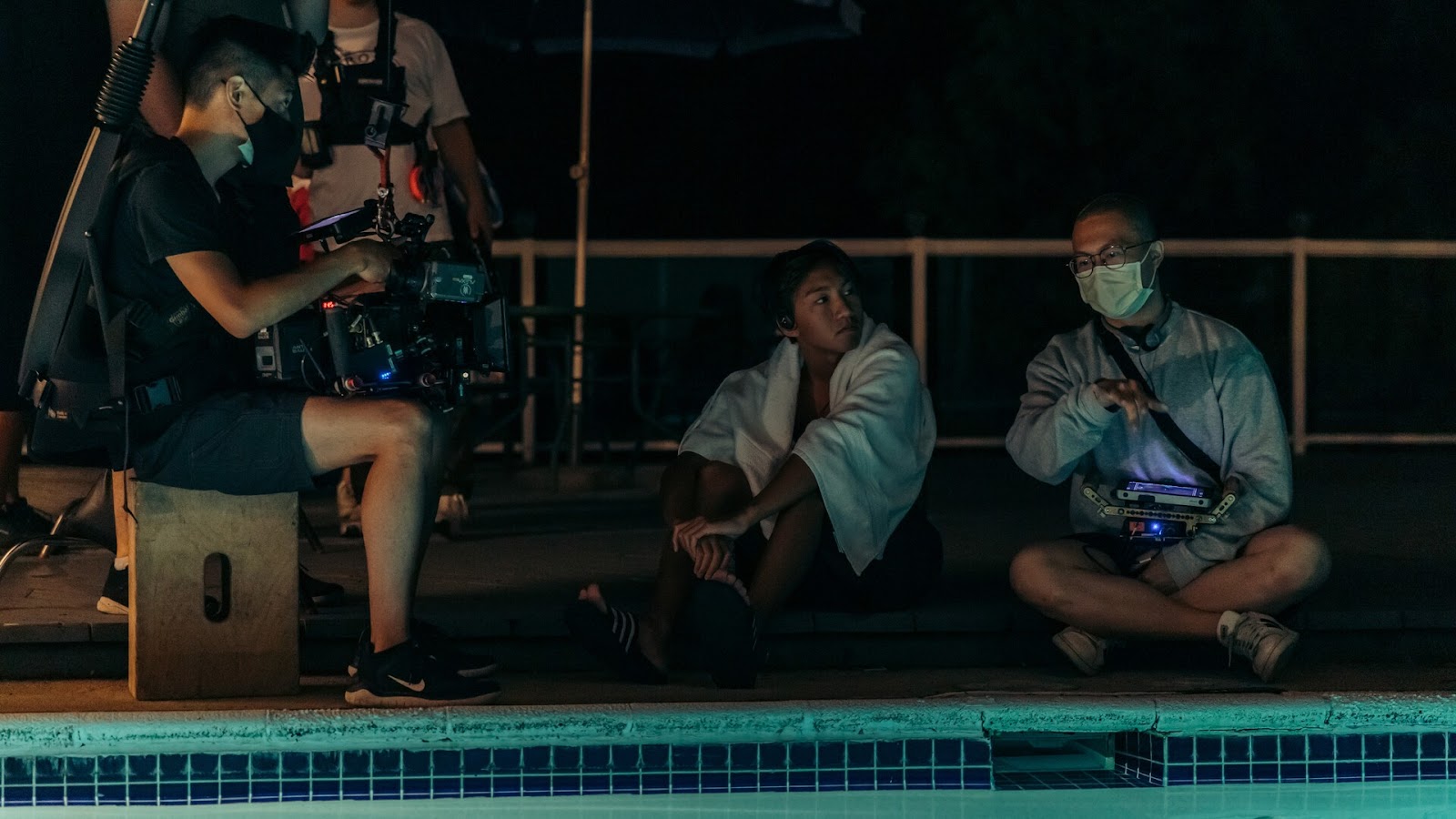
Christopher Yip on the set of Fish Boy
Once you made that decision, how did you learn the craft? Did you study film formally or learn on the job?
I did the Television and Film program at Sheridan. It was just one year, which I liked, because I was eager to start learning on the job. I learned a lot just from observing other Directors in class. But honestly, a lot of it was trial and error.
I remember stepping onto the set of my miniseries Streams Flow From a River, and I was really nervous. Until then, I’d only made shorts with two- or three-day shoots. This was different. But the story was really important to me. It was a response to anti-Asian hate generated from COVID, and I felt a responsibility to tell a story by and for the community. I didn’t know if I could pull it off, but I had an amazing team: my Director of Photography, Allen Liu, the Producers at Fae Pictures, and the whole cast and crew. That’s where I learned that so much of directing is in the prep and communicating your vision clearly to your department heads, making sure everyone’s on the same page. I’m really grateful.
The intersection of queerness and faith is such a powerful theme. Did your own story inspire Fish Boy?
Fish Boy was the first thing I ever wrote, and it’s very much a snapshot of who I was in 2016 or 2017, before I moved to Toronto. I try not to be too hard on it, but it’s like looking at your teenage photos. Cringe! Today, I feel like some of the dialogue is rough and it lacks nuance, but it’s true to where I was then.
It was based on my teenage years in the church. I wanted to write what I knew, and for me, that meant growing up in a very Christian, very Chinese household where there wasn’t space to explore queerness. I was yearning for that freedom. It was like, “If I can’t have the conversation with my family, maybe I can have it through film.”
It’s something I still wrestle with. I recently went on a family cruise, our first big vacation in five years, and it made me think about how my parents shaped me. They were the biggest influences on Fish Boy. When I screened it for them, it was terrifying. Coming out was hard. There’s that swirl of emotions: Will they accept me? Have I already been too much of a burden?
But now that I’m older, there’s peace. We’ve found this weird middle ground. And that’s what interests me, the moral gray. When you’re younger, everything feels black and white. But change is possible, even when it doesn’t seem like it. I’m grateful I can work out those feelings through film. It’s like therapy.

The crew of Yip’s first short film, Fish Boy
What was it like writing a multi-episode arc for Streams Flow From a River instead of a standalone short?
It was definitely scary—it was my first time doing that. I got my first writing credits in kids’ TV through BIPOC TV and Film, so I had some experience in a writer’s room, but it was the first time I led one. But I do have to credit Abdul Malik, my Executive Story Editor, who worked with me to map out the whole series format.
The whole hope for the series was “passing the mic” and having a spotlight on each of the characters within a family so it didn’t feel imbalanced, and we got a chance to see how each of these characters was feeling and reacting. Especially for the Mom and Dad characters, we look into their stories from before they were parents, the things that they didn’t tell their kids. We see them as fully formed adults, but they used to be kids with hopes and dreams, too. And in those episodes, we get to see the mom wrestle with her latent feelings for someone other than the man she’s married to, and we see her husband deal with his dreams for Canada come crashing down around him, turning to alcoholism and substance abuse. But I do have to credit Abdul and the other amazing writers in the writers’ room for Streams: Leonard Chan, Marushka Almeida, Lelinh Du, and Minh-Anh Vo Dinh. Putting such a personal project in front of a group of people can be very vulnerable, but I got really lucky – everyone understood the story and added their own spin on it.

Cast and crew at the Cannes International Series Festival for the world premiere of Streams Flow From A River in 2024
“I wanted to write what I knew, and for me, that meant growing up in a very Christian, very Chinese household where there wasn’t space to explore queerness…It was like, “If I can’t have the conversation with my family, maybe I can have it through film.”
Director Christopher Yip
Are there stories or perspectives you feel still aren’t being represented onscreen?
It felt like during the pandemic there was a clear push for diversity and for queer, trans, and BIPOC stories. But now that DEI budgets are being slashed, and diversity doesn’t automatically equal money at the box office, it kind of seems like things are regressing.
It’s tough because it takes years to get a story made into a film, especially if it breaks the mold. When I first started, I was naïve and thought, “My story is fresh, so of course it’ll get made.” But the more I learn, the more I realize how hard it is behind the scenes. It’s a long game.
I’ve volunteered with BIPOC TV & Film, and one of their mantras is, “There’s space at the table for everybody.” But the reality is: funding is tight, and taking a chance on a new voice is seen as risky. I still believe fresh voices are what breathe new life into this industry. But we can’t do it without support from people with experience and financial backing. We need people to trust us.
I’m excited to see what indie filmmakers in Canada are going to bring to the table. My Producer friend, Malachi Ellis, is starting a new production company called Area V5 Pictures with Nic Altobelli and Lauren Saarimaki, and they’re breaking into the indie space. I really look up to Directors like Zarrar Kahn, Tyler Evans, Joyce Wong, Aleysa Young, and Deborah Chow, and I’m hugely grateful to be part of the DGC National Directors Division mentorship program. My mentor Kathleen Hepburn is amazing, and she’s talked me through a lot of uncertainty the last few months. Her film The Body Remembers When the World Broke Open is so iconic, and I’m so grateful to be able to chat with her and see her process.
Can you talk about what’s next for you?
Recently, I shadowed on Son of a Critch through the Warner Directors Program. It was an amazing experience, such a well-oiled machine, and everyone was so welcoming. Getting to work with legendary people like Malcolm McDowell was incredible. I also shadowed on Small Achievable Goals with Aleysa Young.
Right now, I’m executive producing, writing, and directing some episodes of Thread, a queer horror short-form series with Archipelago Productions. And I’m developing my first feature, another queer horror piece. I’m trying to lean into genre, particularly horror and sci-fi. With Fish Boy, I took that feeling of “there’s a monster inside my body” and used it to express how I felt about queerness and being trapped in a space that wouldn’t accept me. Horror gives you a creative, imaginative way to explore those very real fears and neuroses.
I’m still learning how to do that kind of alchemy, taking something deeply personal and making it universal. That’s the goal.
Watch Fish Boy on CBC Gem and Streams Flow From a River on Super Channel. Fish Boy will also open the Toronto Outdoor Picture Show’s screening of Moonlight on July 10th at the Corktown Commons.