Co-presented by TIFF Industry and DGC Ontario, the event highlighted the remarkable contributions of Toronto-based creatives to this unique series. Now in its sixth and final season, the show has provided a playground for talented local creatives to grow into new roles and stretch the boundaries of their craft. Tickets for the event sold out within hours, signalling just how much fans and industry insiders alike were craving an intimate look at the magic behind this hit series.
The evening kicked off with the premiere episode of the final season, setting the stage for a lively panel featuring Showrunner Paul Simms, Production Designer Shayne Fox, Costume Designer Laura Montgomery, and Stunt Coordinator and Director Tig Fong. Moderated by film critic and programmer Emily Gagne, the panel dug deep into the creativity, challenges, and laughs shared over the six seasons that defined What We Do in the Shadows over the years.
“The beautiful thing about this show is, yes, there’s a whole set of rules, but there are also no rules. Working on What We Do in the Shadows was a dream project because we could define our own rules and then break or bend them.”
Production Designer Shayne Fox
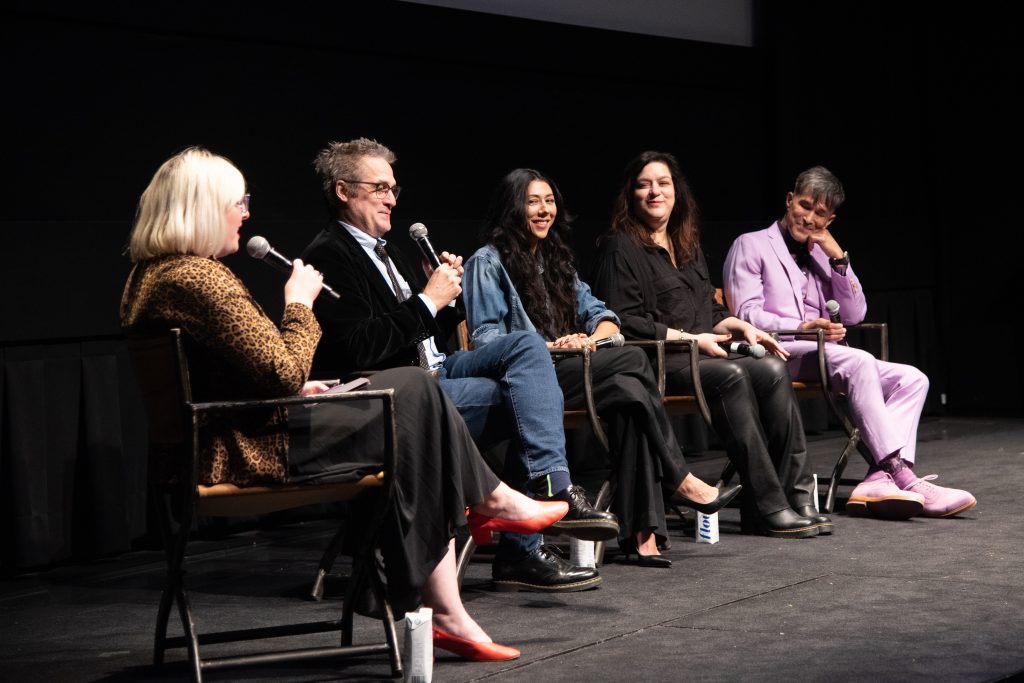
From left: Moderator Emily Gagne, Showrunner Paul Simms, Costumer Designer Laura Montgomery, Production Designer Shayne Fox, Stunt Coordinator & Director Tig Fong
More than just a practical location, Toronto provided access to skilled local talent essential for the show’s creative needs. “We knew that the budget for the show was the same as it is for a regular half-hour show,” Showrunner Paul Simms noted, “and we had a lot of expensive stuff to do. Toronto was a place where we had people who could help us with our very ambitious ideas.”
“From the outside, this is a show that looks quite Hollywood, whereas, in actual fact, it isn’t. It’s a Canadian show made up of a Canadian crew, who is responsible for all this – the costumes, the makeup, the whole lot. Don’t forget that. As cast, and especially us Brits who’ve come over, we won’t forget that either.”
Actor Matt Berry

Shayne Fox started as a Set Decorator on the series before eventually taking over as the Production Designer for Seasons 4, 5, and 6. “The Production Designer at the time left the show, and Shayne had done three years of doing set decorating so I knew her quite well. A lot of the writers would come down to the set and go, ‘Oh my god, where did you find that? Look at all this amazing stuff,’” recalled Simms. “I took a real chance, but Shayne was already so good at her job that it was a great decision to promote her.”
Recalling the creative challenges behind the vampire mansion, a set that has become iconic among fans, Shayne laughed, “When I stepped up into the role of Production Designer, the first line of the first script of Season Four was, ‘The house is completely demolished, decrepit, and falling apart.’” She continued, “It’s a constant process. We came up with a palette of destruction: ooze coming out of walls, things that had been burnt, a bathtub falling through the ceiling…It’s all about adding to the world while keeping it dynamic and interesting.”
“There’s a sort of a code of what vampires can and can’t do,” continued Shayne. “They don’t have reflections. They can’t be near silver. But the beautiful thing about this show is, yes, there’s a whole set of rules, but there are also no rules. And we leaned into that, at least I did as a creative person. I look for the loopholes and the rules we can push. It was a dream project because we could define our own rules and then break or bend them.”
“When I stepped up into the role of Production Designer, the first line of the first script of Season Four was, ‘The house is completely demolished, decrepit, and falling apart.’”
Production Designer Shayne Fox
Costume Designer Laura Montgomery also shared her story of being promoted to her current position after the original Costume Designer on the show departed. “It felt, especially with a show like this, to promote from within,” commented Paul Simms. “Someone who knows the city and everyone who works here and how we do it, instead of trying to bring in some brand new person who’d have to learn it all over and very quickly.”
Montgomery revealed how each character’s look reflects their individual stories. She explained, “We inherited the conceit from the What We Do in the Shadows movie that the vampires get stuck stylistically in the period in which they were human.” For Nandor, that meant a 1400s Persian-inspired wardrobe, but as per Shayne’s earlier comment, rules can be bent or broken. Montgomery added that one of her favourite parts of designing costumes for the show was the freedom to explore different historical periods: “Oftentimes on a period show, you’re in one very narrow time period. But because this show is set in the present day, featuring characters who have lived for centuries, you have the latitude to do anything.”

“It felt right, especially with a show like this, to promote from within instead of trying to bring in someone brand new who’d have to learn it all over and very quickly. [Laura] is someone who knows the city, everyone who works here, and how we do it.”
Showrunner Paul Simms
Stunt Coordinator and Director Tig Fong outlined their unexpected journey from coordinating stunts to directing episodes. “I found a way onto the show by being lied to,” Tig joked. “They told me, ‘It’s just this little comedy show… you’re probably going to work a couple days a week. You fly a vampire now and then.’” In reality, the stunts required much more preparation, and the writers began adding more elaborate scenes as they realized what was possible with Fong’s skill and expertise as a Stunt Coordinator. “You have to make the stunts look and feel real within the supernatural, and that’s the fantasy of the show. By the final season, we had Laszlo sword-fighting with 16 faceless people in masks. It was a constant challenge, but it made the show so much fun to work on.”
“I love the Jackie Daytona fight,” Tig shared, referring to a bar brawl between two vampires in Season 2. “We built that fight on the spot in about 15 minutes. It was one of the fastest fights I’ve ever done in film.” Tig also highlighted the Night Market episode in Season 4 as another that stood out for them. “It was an incredible set, and I wanted the fight elements to live up to it. We had Guillermo doing parkour off cars and an actual sword fight between two lead actors, each in a different fighting style. They performed almost the entire fight themselves, and it’s one of my proudest moments.”
“I am forever grateful for the show, but I’m also grateful for the opportunity that Paul gave me when he allowed me to take the reins as a Director. I got to direct Episode 309, and then, once again in Seasons four and five – including the Season 5 finale.”?
Stunt Coordiantor & Director Tig Fong

Tig also spoke about the incredible opportunity the show presented them: being able to direct multiple episodes for the first time in their career. “I am forever grateful for the show, but I’m also grateful for the opportunity that Paul gave me when he allowed me to take the reins as a Director. I got to direct Episode 309, and then, once again in Seasons four and five – including the Season 5 finale.”?
The panel wrapped up on a reflective note as the panellists shared their thoughts on bringing the series to a close. “A lot of shows, when they get to their final season, get very serious or too sentimental,” said Showrunner Paul Simms. “We really wanted to make it funny all the way through. We don’t want the whole season to be about how this is all ending. It’s all about making it super funny while keeping the spirit of the show alive.”
For the Toronto-based crew, the panel was a celebration of their hard work and dedication to bringing this uniquely funny, supernatural series to life in Ontario. As the series bids farewell, What We Do in the Shadows leaves a lasting legacy in the local film landscape. This final season is not just the end of a show but a testament to the Ontario talent that has made it possible. “It’s always been about the people, the creativity, and the fun of making something entirely our own,” says Paul Simms. As actor Matt Berry says in a video recorded on the last day of filming, during an on-set party to celebrate his birthday: “From the outside, this is a show that looks quite Hollywood, whereas, in actual fact, it isn’t. It’s a Canadian show made up of a Canadian crew, who is responsible for all this – the costumes, the makeup, the whole lot. And don’t forget that. As cast, and especially us Brits who’ve come over, we won’t forget that either.”
“We had a lot of expensive stuff to do. Toronto was a place where we had people who could help us with our very ambitious ideas.”
Showrunner Paul Simms

Showrunner Paul Simms, Costumer Designer Laura Montgomery, Production Design Shayne Fox, Stunt Coordinator & Director Tig Fong
Thank you to TIFF Industry for collaborating with us on this special event, as well as to our wonderful panellists and all of the Members who attended!