“It’s all about playing with expectations. I knew this moment would stick with viewers— giving them something to laugh at, but also something to think about.”
-Kelly Fyffe-Marshall
Documented by guest contributor and Director Chris Deacon.
CSA- award-winning Writer, Director, and activist Kelly Fyffe-Marshall constantly seeks new ways to address complex issues through her art. “My projects always have a message that’s super important to me,” says the self-titled afro-diasporic impact filmmaker: “How can I change perspectives? How can I incite conversations”? In directing the Crave series and CSA 2024 Best Comedy winner, Bria Mack Gets a Life, created by DGC Member Sasha Leigh Henry, about the trials and tribulations of a 24-year-old Black woman navigating a predominantly white world— Fyffe-Marshall employs comedy to impart her message.
“Something that happens to Black folks is you’re often mistaken for an employee,” she says, referencing a scene where Bria (Malaika Hennie-Hamadi) is mistaken for a parking valet. “There are so many times I’m in a space, and I’m like—‘I don’t work here— I’m wearing the same thing you’re wearing.’ And so it’s a funny bit where Bria is handed keys like she’s the valet. But also in that moment, so many people of colour are like, ‘I can relate to that.’”
And now, DGC Ontario Director Kelly Fyffe-Marshall, in her own words:

1. In the first shot of this scene, Bria Mack and Black Attack are outside the country club, high off weed cookies, and eating all the food they can muster. We had to break the scene into three parts across three different locations. Bria is the protagonist in the show, a 20-something Black woman fresh out of university navigating a mainly white world. Black Attack is her invisible hype girl, who rescues Bria from the insanity of the real world.
I really wanted to make the characters feel small and isolated in the frame—like that disorienting, insular feeling you get when you’re high. As a part of the visual language of the show we had decided to shortside our shots, I really enjoyed it the most in wide shots. Funny Story: Malaika had never been high before, but just a week before filming, she accidentally took too much cold medicine. For the first time in her life, she felt a little high. She was able to tap into that experience for the scene, which made everything feel so much more authentic. We all had a good laugh about it, but it definitely added a special touch to her performance.

2. This scene captures a moment many recreational weed smokers can relate to—the familiar experience of eating food to come down from a high. The food tastes so much better, and it becomes almost an entire sensory experience. I knew that the humour of this moment would speak for itself, so the camera didn’t need to do much. There aren’t really any movies that show Black women smoking weed in a comedic light. We’ve got films like Pineapple Express or How High, but when it comes to Black women, the narrative is often limited to stereotypes. This was something really important to both Sasha Leigh Henry (the creator) and me to address.
The day we shot this was windy and cold, so we had to improvise. We put up a flag behind the actors to block the wind, but it wasn’t without challenges. My DP, Gayle Ye, and I had to be resourceful—tightening the shot and blowing out the background to avoid showing the chaos of everything becoming air-bound, even video village. The improvisation in that moment really paid off and I really ended up loving these shots.

3. This wide shot swings to the left, following Bria as she walks inside, and I wanted it to feel like a sharp transition—from her carefree fantasy world, the one set to the rhythm of Black Attack, to the harsh reality awaiting her. It’s a moment many Black folks can relate to: that awkward experience of being mistaken for an employee. I wanted to bring a comedic twist to it as a way to shed light on the situation. The shift needed to feel sudden— almost like a wake-up call— so that people who haven’t experienced it firsthand still feel the impact of that moment. It’s about using humour to highlight a shared reality, making it both relatable and accessible.
I wanted to feel the layers in this shot— the old brick wall representing old money and the institution and the Porsche in the foreground representing new money—with Bria wearing colour trapped in between. Knowing we’d later reveal that this was Gemma’s entitled mother, I made sure to incorporate similar mannerisms between the two characters to subtly foreshadow the relationship and dynamic to come.

4. We cut to another shot where we deliberately short-sided the framing. We didn’t have any extreme close-ups as a part of the visual language, but I wanted to get as close as possible to capture Bria’s confusion in detail. It’s that exact moment when you feel the high starting to wear off, and everything becomes a little clearer—and more awkward. Malaika did a fantastic job portraying this emotional shift, perfectly balancing the feeling of being high, confused and offended all at once. It was a delicate moment, and I wanted the audience to really feel it through her performance.

5. In this shot, my intention was to keep the focus squarely on the car keys. The most insulting moment occurs when Gemma’s Mother holds out the keys, clearly expecting Bria to take them. That’s where Bria’s attention is directed, which allows us to also capture her mother’s reaction in the background. By cutting back and forth between this shot and the close-up of Bria, we heighten the comedic tension. The contrast between their reactions—Gemma’s Mother’s prejudice and Bria’s discomfort—adds an extra layer of humour, letting the audience feel the awkwardness and underlying tension without needing words.

6. This was the perfect moment for Black Attack to make her entrance. By this point, after four episodes, I knew the audience would have developed a sense of when Black Attack was going to show up— but what they wouldn’t expect was her Harriet Tubman-esque outfit (she’s always dressed for the adventure). We wanted to catch them off guard with this bold choice—something that would shift the tone and add an unexpected layer of humour and commentary. It’s all about playing with expectations, and I knew this moment would stick with viewers, giving them something to laugh at, but also something to think about.
This entrance from Black Attack leads Bria into a fantasy departure named “Underground Railroad.”
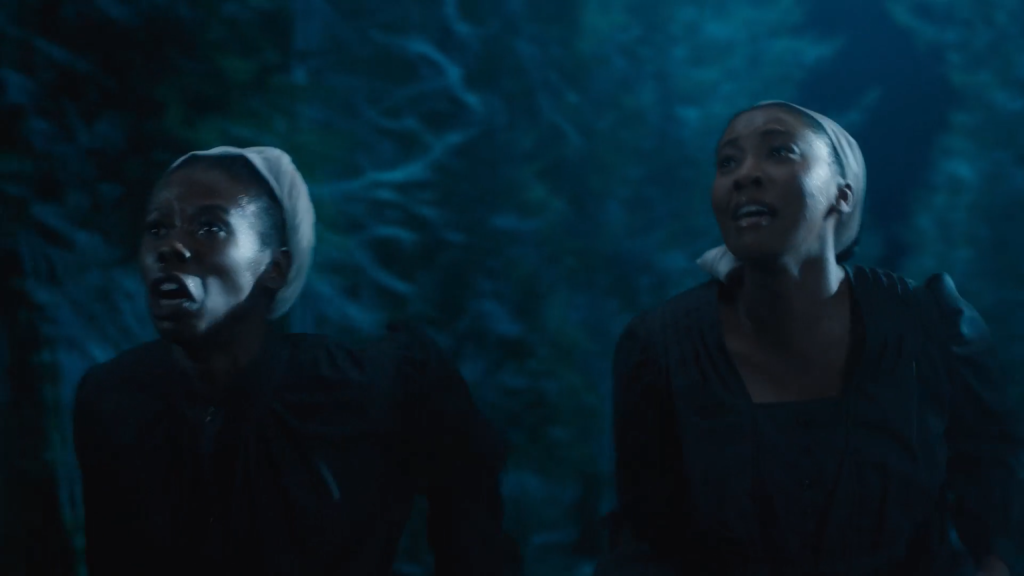
7. Our first shot for our underground railway fantasy departure was filmed at 2D House. It was my second time working with an LED volume wall—previously, I had used it for a driving scene. This time, I really relied on my DP, Gayle, for her technical expertise. As I worked with the actors and Production Design team, she worked with the technicians to help bring the world to life. The biggest challenge was that the perspective of the visuals was directly tied to the camera and lens, which required an additional technician to keep everything in sync and maintain that seamless flow.
Our Production Design team, led by Ben Gerlis, played a huge role in bringing the vision to life. They carefully selected the video for the wall and arranged the use of treadmills, which needed to be perfectly timed with the movement of the visuals. It might sound straightforward, but getting that level of synchronization right took an incredible amount of precision. Even though this shot turned out to be one of the easier transitions to accomplish, it still demanded a lot of coordination across various departments. Our Makeup Artist, Antonio Hinds, also did an outstanding job with the sweat effects, adding an authentic touch to the scene.
A big shoutout to Gayle and our Key Gaffer, Mario Vertolli, along with his assistant Phil Zita Jr. (RIP), for creating such an immersive world. The lighting was absolutely crucial to setting the right tone, especially as Bria and Black Attack moved through the forest. We carefully played with light and shadow to match the natural ambiance of the environment, using the darkness to deepen the atmosphere.
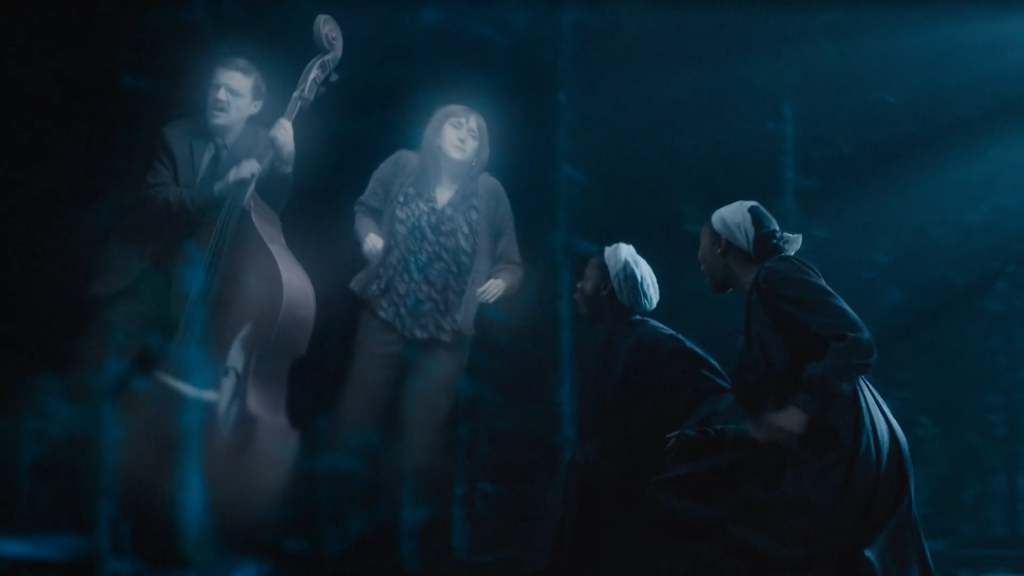
8. We spent a lot of time finding the right angle for this shot, especially since the ghostly mirage would be added in post-production. I directed the actors to react as if they were seeing the scariest monsters projected throughout the forest, and that sense of fear and surprise was key to making the moment feel genuine.
The ghostly mirage element was actually shot earlier at the country club. During rehearsals for this segment, Mark Forward (who plays Frank) and Shannon Jardine (who plays Cheryl) completely surprised me. They came up with their own “Afro-Canadian spiritual” to enhance the moment, and it was hilarious and perfect. They brought such a unique energy to the scene, adding their own comedic twist that took it to another level. Their improvisation injected just the right mix of humour and absurdity, giving the scene a balance that I hadn’t expected but absolutely loved. It was one of those happy moments where the actors’ creativity shines and elevates the material beyond what was on the page.

9. In this shot, Black Attack urges them to jump on a train, and Bria quickly corrects her, pointing out that the Underground Railroad wasn’t actually a train. It’s a funny moment, made even more comical by the actors shouting over the noise of the imaginary train. We shot this inside the country club, and finding the right location was key. We needed something that felt dated and completely different from the conference room scenes.
The year before, I had visited a stop on the Underground Railroad in Detroit, and I really wanted to emulate that long, haunting hallway. So, we had Bria and Black Attack run down a hallway and open a door (which actually led to a bathroom). We set up a fan in the doorway to create the illusion of a train passing by, adding to the absurdity of the moment.
And as a fun little nod, this shot is also a playful reference to Porsha Williams from Real Housewives of Atlanta, who famously came to the realization that the Underground Railroad wasn’t a train, a moment solidified in pop culture.
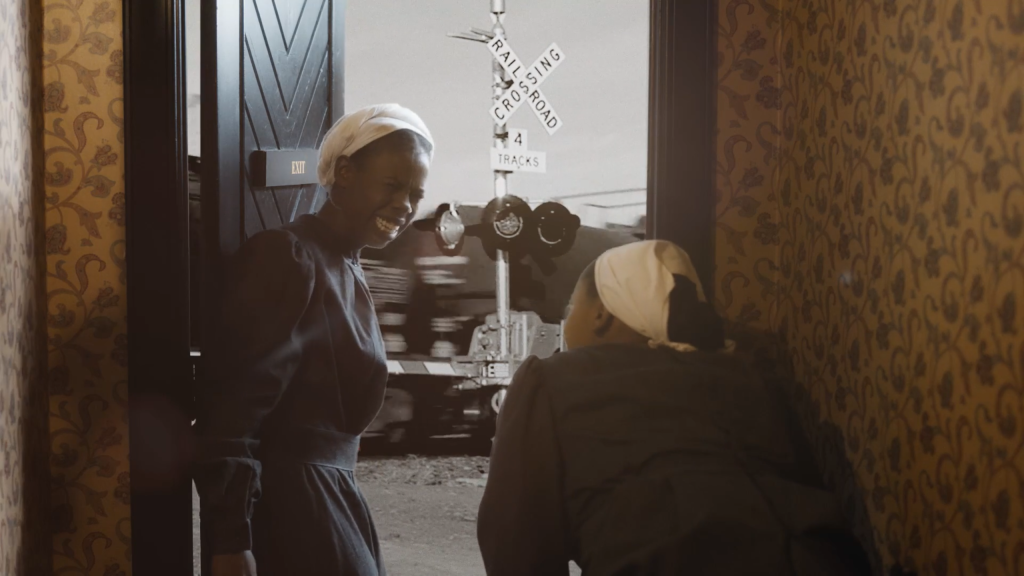
10. Once we entered the hallway and started blocking the scene, Gayle and I quickly realized the space was too tight for singles. But honestly, I think that worked to our advantage and really helped elevate the moment. The actors had to play off each other more, reacting in real-time, which brought out the comedy in ways we hadn’t anticipated. It was a great example of how limitations can lead to creative solutions.
The train itself was green-screened on the day, so we didn’t really know what it was going to look or feel like in the final cut. Directing actors through those kinds of moments is always a challenge, especially when you don’t have a clear visual to reference. But I focused more on the comedic beats, the delivery, and the reactions, knowing the visual effects would come together later. The actors really did a fantastic job of grounding the humour, making it land even without the full picture.
Watch Bria Mack Gets A Life on Crave.