Rooted in mentorship, mutual support, and queer joy, QUIP is creating opportunities for emerging creatives while helping strengthen community across every stage of Post. Maureen and Michelle share their vision for QUIP’s future and the community they hope to keep growing along the way.
Can you tell us about how QUIP first came about?
Picture Editor Maureen Grant: I had been thinking about what a queer Post Production advocacy group might look like before QUIP came to be. Even as a female Editor, I found it difficult to gain support and find opportunities, and most of the existing mentorship programs were for female Directors or writers. I had also seen wonderful initiatives that promote and mentor queer talent, but in above-the-line and on-set roles. I have always believed that the creative aspect of storytelling continues through Post Production and that diversity in Post leads to better creative work. I wanted to form a group to raise visibility for others facing the same challenges, but I wasn’t sure how to go about it on my own.
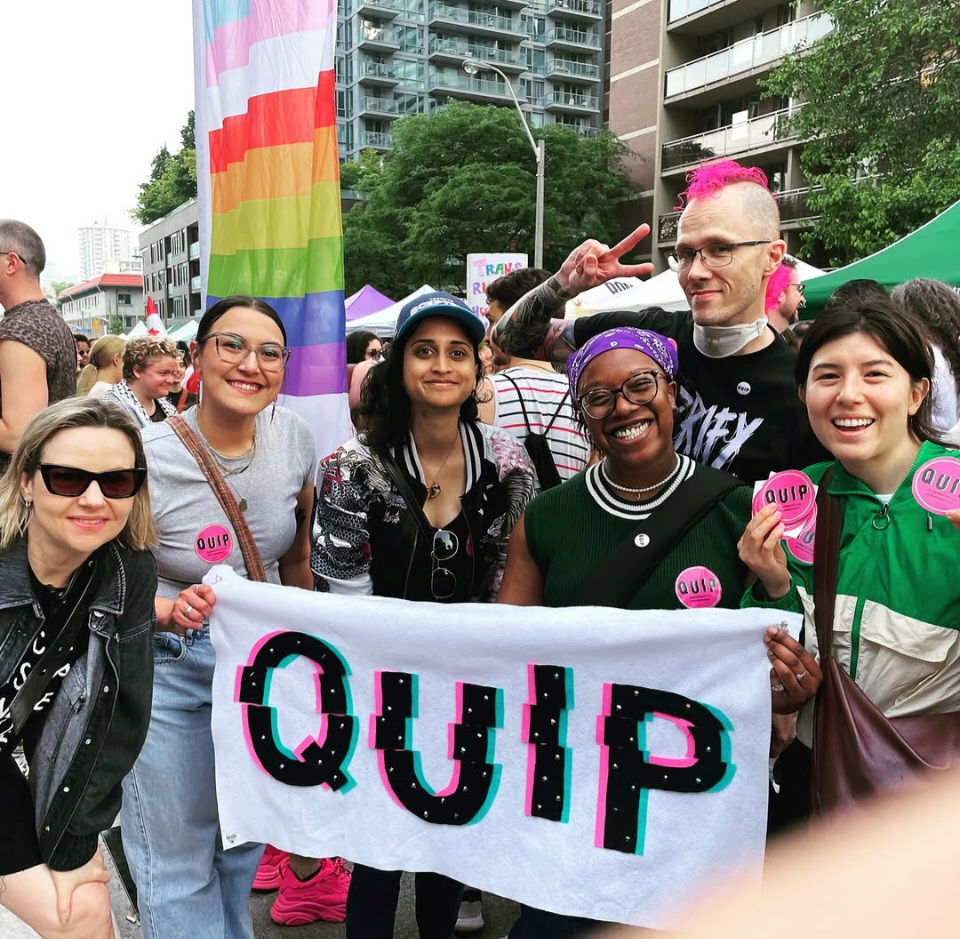
I met with Michelle Irving, a Sound Editor and Re-Recording Mixer who I’ve been in touch with over the years, and we decided it was worth a try. We decided to start small and see what happened, with very little expectation, and launched with a pre-TIFF party hosted by Rolling Pictures and sponsored by DGC Ontario. We had a great turnout, at least 60 people showed up. At first, it was just an Instagram account, but now it’s evolved into a talent hub, workshops, and networking events, in essence, a community.
Sound Editor Michelle Irving: I was doing a lot of work at Rolling Pictures and so was Maureen. They’ve been very supportive of women in Post and Indigenous filmmakers. They were very receptive to allowing us to use their space to host the first meetup.
It was exciting because it was a real cross-section of people. We had young people at the beginning of their careers, and then we had some senior, seasoned folks represented. The idea was to create a connected community where we could start providing advocacy and visibility. What you’d hear repeatedly is, “We would totally crew queer folks, but we can’t find anybody.” Now, opportunities are even happening informally in our group, and I’ve been able to recommend people for projects that provide mentorships.
We’ve done a colour workshop at Urban Post, a sound design workshop at Rolling Pictures, and Careers in Post, a full-day workshop for 2SLGBTQ+, non-binary, and gender-diverse talent with Trans Film Mentorship, hosted by DGC Ontario…What we’re trying to do now is build an ecosystem of queer practitioners who all know each other and can work together.
Picture Editor & QUIP Co-Founder Maureen Grant
What was the response from the community? Were people excited, or were some people nervous about putting themselves out there? Was the community ready for something like this?
Maureen Grant: The response was phenomenal. We were happily surprised by how many people responded to the first event and sought a sense of community. QUIP is now run by a fantastic committee, and we’ve seen how supportive our industry has been as well, and willing to help us.
Michelle Irving: I think Sound people were ready because there’s a real gap in community supports, particularly in Sound. There isn’t enough Black or Indigenous representation in Sound teams in Ontario either. There are reasons for that – some of them are systemic, but there’s also the fact that many people go into the music side of the Sound industry, and they don’t know how to enter the Post Production side. I didn’t professionalize until my 30s because I didn’t know how to access it.
Michelle, since you’re from the Sound side of Post, what has the response been from Sound Editors? Were they happy to have a space that spoke to them, especially when there are relatively few?
Michelle Irving: Definitely. Even for me, I only knew one or two other queer-identified Sound people. Now there’s a little cohort I know, some of whom I’m involved with mentoring. When I was professionalizing, I had my mentor, Sound Mixer/Supervisor Daniel Pellerin, and he was also training up Bret Killoran, another Sound Mixer and Supervisor. They were generous with their time, and that was great. But as I spread further into the Sound world, I had a feeling that if I had a question, I didn’t want to expose myself to people I didn’t really know or trust. That’s a significant thing: to feel there’s a safe space where you can ask questions to learn and advance, rather than staying in that isolation of being unsure and hoping you’re going to figure it out. I felt very comfortable and supported by Daniel, but not everyone finds someone like that when they start out.
What was that first year of QUIP like?
Maureen Grant: After the TIFF event, we realized we were growing a community and that we had a huge list of names registered for our newsletter. Eight of us from the Post community met for dinner as a committee and talked about what this could be over the next year. There are different facets to it, and one is asking how Producers and Directors find queer talent in Post. Many of them want to hire queer people in the industry, but there was no way to find them beyond word of mouth. Another facet is how queer Post practitioners find each other, because there hasn’t really been a collective space for them. Recently, the awesome people at CRRAL made us a hiring talent hub and job database for free on quip.crral.com. People have signed up from multiple cities, not just Toronto, but across North America, so it seems to be filling a need. In that first year, we mainly focused on networking parties. Sweaty Betty’s, a queer bar on Ossington, let us use its space for so many meetups. We had a huge Pride party, which I think challenges the idea that Post people are all quiet and solitary! That’s when it started to gel, and we felt we could make this something that addressed a long-term need in the community. Anyone who is interested is welcome, and we try to be barrier-free. What we’re trying to do now is build an ecosystem of queer practitioners who all know each other and can work together. If I get hired or I’m asked for recommendations, I can help with your whole Post workflow because this network exists.
It’s important that people look at the visibility we’re trying to create and not assume that queer people only want to work on queer content. It should be about recognizing that every production benefits from a different point of view, whether the central storyline is about a queer person or not.
Sound Editor & QUIP Co-Founder Michelle Irving
What kinds of training initiatives is QUIP working on?
Maureen Grant: We’ve done a colour workshop at Urban Post, a sound design workshop at Rolling Pictures, and Careers in Post, a full-day workshop for 2SLGBTQ+, non-binary, and gender-diverse talent with Trans Film Mentorship, hosted by DGC Ontario. We just completed our first iteration of a four-part course called Demystifying Post Production, by and for the QT-BIPOC community, teaching the fundamentals of Post supervision, editing, sound, and colour, and best practices for moving between them. This was hosted by TMU and funded by the City of Toronto’s Film Office, and produced in partnership with Inside Out.
We wanted to create a course that is about what each phase involves, and how to navigate the workflow – for those working in pre and production, as well as for those who want to understand the bigger picture of Post. We just received a second grant from Film Toronto to run another iteration of the course, so we’re in the beginning stages of planning that.
Michelle Irving: Funding is one of the biggest challenges. We’re not a nonprofit so it limits what we’re able to pull in. But I’m amazed by how much we’ve been able to accomplish through volunteer work. One of the things we’ve wanted to do is to have an event where we invite producers and Directors from not only queer-focused productions, but any production, and have them come and meet our Members at a semi-informal meetup.
Post is a world that isn’t as visible a part of the production process. Do you find it’s especially important to make those connections?
Maureen Grant: It’s connection-based, not in terms of who you already know, but whose trust you have gained, because people want to trust who they bring on board. It’s a tough job to learn when you’re green, because working your way up as an Assistant Editor is very different from cutting. Editing is in this other creative universe, with drawing parallels to other shows, finding the tone, music, and sound. It requires a lot of trust and collaboration with Producers and Directors. You are entrusted with finding the tone of their project, and there aren’t many ways to learn besides shadowing or mentoring. I was lucky enough to go to the CFC in the Editor’s lab, so I finally had a mentor and this community of Editors. We all learn from each other. You have to get your hands dirty to get good at this.
Michelle Irving: It’s been nice being able to create a space where those connections can happen. Otherwise, award season — if you happen to be nominated — is one of the only times you get to see the other people who work in dark rooms. It can be intimidating for young people, or queer-identified people, to put themselves in spaces and ask for opportunities. It feels a little safer if it’s coming from something like Queer in Post.

Before QUIP I don’t think there was a tangible way beyond word of mouth to find other queer-identifying creatives and technicians. This visibility has also become a source of pride in that we provide safe spaces for others to work in, and that is profoundly important whether you’re a filmmaker who is searching for Post crew that understands your material or if you can offer a different point of view to a project.
Picture Editor & QUIP Co-Founder Maureen Grant
Why do you think a space like QUIP that celebrates and uplifts queer talent is so important?
Maureen Grant: Before QUIP I don’t think there was a tangible way beyond word of mouth to find other queer-identifying creatives and technicians. This visibility has also become a source of pride in that we provide safe spaces for others to work in, and that is profoundly important whether you’re a filmmaker who is searching for Post crew that understands your material or if you can offer a different point of view to a project. What has struck me with the creation of QUIP is how it has created a community of support and interconnection, and I’ve seen careers take off, collaborations happen. It has brought together emerging and established folks and created mentorships and job opportunities, we’ve been getting support from companies providing workshop instructors and spaces, financial support, and aligning with organizations like the Canadian Cinema Editors, who sponsor us. It’s given others a way to be part of this work.
Michelle Irving: It’s important that people look at the visibility we’re trying to create and not assume that queer people only want to work on queer content. It should be about recognizing that every production benefits from a different point of view, whether the central storyline is about a queer person or not. What would be ideal is if the industry at large, when they’re crewing, thought: where can we pull from to get an interesting, intersectional team to tell this story? We hope that QUIP would be one of those no-brainer resources.
Do you feel QUIP has changed how you approach your own work and career?
Maureen Grant: I wish that something like QUIP existed when I was an emerging Editor, so it’s incredible to see it happening now. I’m so happy to be able to advocate for others, mentor, and give back. Having someone to give you career advice can be a lifeline. I’m lucky to have had Editor David Ostry at the CFC as a mentor and friend, and now I’m taking on that role for others. For me, QUIP is about creating a culture of community and collaboration. There is currently momentum to create a Queer Screen Alliance, something people have been thinking about for years. QUIP has allowed me to be part of this discourse about queer filmmaking in Canada, and I’m proud to be involved.
Michelle Irving: I think it’s given me a sense of validation, that I have knowledge I can offer to other people. The thing about teaching is that you continuously learn by passing down information, which deepens your knowledge in your area. And there’s always something that somebody just starting out in the field brings. They have this curious beginner’s mind, and they’re probably going to find something in the workflow that you hadn’t thought of yet. Then it becomes part of your workflow as well.

What’s next for QUIP in 2026 and beyond?
Maureen Grant: We’re currently planning a pre-TIFF launch party that wraps up our accomplishments from the past year and celebrates the amazing instructors who have given their time, our grads, and QUIP members who have won CSAs, have something at a festival this year, or have been screened at TIFF. And in the fall, Demystifying Post Production will be opening applications for the next workshop. We’re hoping to find funding and partnerships for a wage subsidized mentorship initiative in the near future.
It can be intimidating for young people, or queer-identified people, to put themselves in spaces and ask for opportunities. It feels a little safer if it’s coming from something like Queer in Post.
Sound Editor & QUIP Co-Founder Michelle Irving
Is there a favourite Canadian show or movie that you’re really into right now?
Maureen Grant: Obviously, in the past year, Heated Rivalry was one I was a fan of. I also love Empathie by Florence Longpré from Québec. It’s a stunningly beautiful and nuanced show, and navigates tone and fluctuation from heavy drama to levity. I cannot wait to see Antidiva: The Carole Pope Confessions, a documentary about Canadian queer rock icon Carole Pope by Michelle Mama – Michelle has been a strong supporter of QUIP from day one and we can’t wait to see what she does next with GAY AGENDA.
Michelle Irving: I recently watched Undertone, a thriller-horror. It’s all suspense, and the sound design in it is quite sharp. In terms of projects that made an impression on me, from a craft perspective, that one stands out. I also think the writing and concept around Mile End Kicks is great, and I had the privilege of working on that film. Director Chandler Levack is a really talented filmmaker. There’s a lot of very good Canadian content being made, and it seems like the bar is getting higher. We’re breaking out of this idea that people sometimes groan about when they watch Canadian content — “It’s too Canadian.” We’re finding different, interesting voices, and there’s more sophistication and self-possession, which is refreshing.