Drawing from her work across journalism, film, activism and academia, Min Sook reflects on the responsibility and possibility of using film to tell important stories and reach unexpected audiences in innovative ways.
Documentary filmmaking often brings together art, filmmaking and social change. Was that something you were always interested in, or did it develop through your career in journalism and news?
Min Sook Lee: That’s how I got into media. I was a young, politically engaged activist, very involved in many grassroots organizations in Toronto. In high school, I was involved in the anti-apartheid movement, and then I started meeting other activists, especially from the Global South. There were queer women of colour who used the arts to build community, to make sure our stories were told and that we weren’t flattened into pliable, one-dimensional tokens in someone else’s main story, and to find ways to use culture as an active tool for resistance. That was my entry point.

What was the process of learning filmmaking and developing your own creative voice like for you?
Min Sook Lee: I didn’t go to film school, but everyone approaches the work they do as a filmmaker differently. As a documentary filmmaker, your work is about these moments when people are deeply alive and engaging with the pressures that come our way, often negotiating really challenging situations that many of us recognize as familiar, whether or not we have had that exact experience.
Some of the very first opportunities I had on productions came when Dionne Brand was making documentaries with the National Film Board’s feminist film production unit, Studio D, and she gave me the chance to do some stills. Dionne was chronicling the lives of queer Black women in her community who were using their art, such as the musician Faith Nolan and the painter Grace Channer, as a way to defiantly but also joyfully talk about their lives and ideas.
Helen Lee was another filmmaker who offered me opportunities. I did stills on Prey, a short film she made with Sandra Oh and Adam Beach. I watched Helen work with actors, negotiating those scripted moments while remaining open to holding those spontaneous moments when you’re working with actors on set.
Those first entry points were foundational because filmmaking can feel deeply inaccessible if you don’t have the social capital or the economic means to train. I come from a very working-class background, and working in the arts was not something that my family ever entertained. Even thinking that you can be in this space requires different passageways.
Filmmaking and film viewing are deeply emotional, but they’re also intellectual experiences that can have profound political implications. That recognition of what media can do to mobilize what might have been unimaginable came out of political organizing spaces. Through the aesthetics of filmmaking, the framing, and thinking about lens-based storytelling as an expressive art form, I started to find my space. My intuitive, instinctive space is in political organizing, but I know I’ve grown a lot as a filmmaker.
I was on a certain trajectory as a Director, and I didn’t know it at the time. But at a certain point, the kind of work I was encouraged to make was misaligned with the political creative force behind what I wanted to do, so I had to shift. I got my grad degree, and now I teach at OCAD University as an Associate Professor in the Film Department. Teaching gives me the balance of a secure salary and job, but also the space to think creatively with some independence and autonomy.
When did you feel ready to direct your own film? When did you have the confidence as a storyteller to do that?
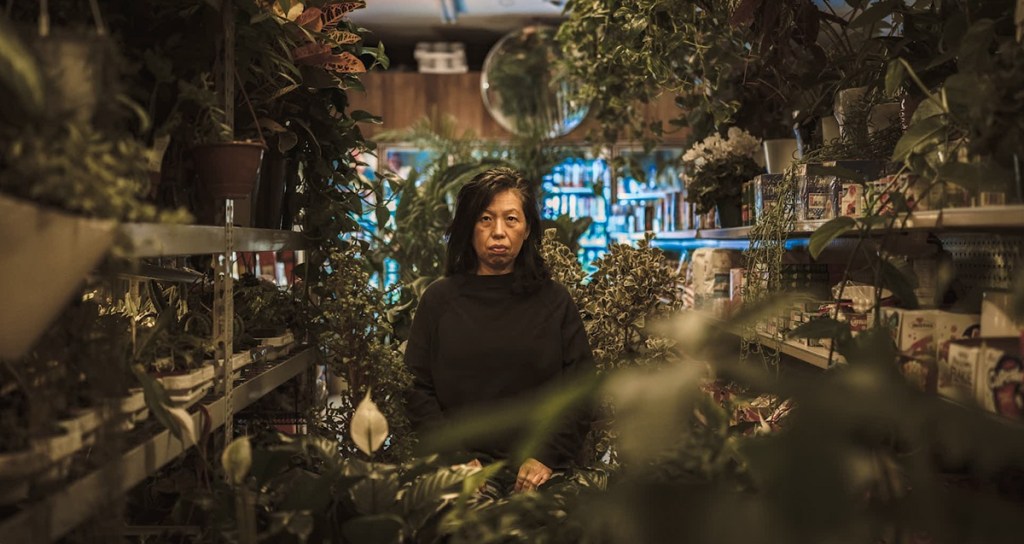
Min Sook Lee: I’m glad you used the word “confidence.” I think confidence is what filmmaking is about. You have to believe in yourself, and if you grew up constantly doubting who you were or didn’t see yourself reflected in the media, it’s really challenging to work from a place with the kind of power a genuine creative voice can have. I don’t know that I ever really had the confidence, but I had the drive to use the tools at our disposal to tell stories that matter and to help people connect to them in political ways.
I started out in community radio for two years as a news director for CKLN Radio, 88.1 FM. CKLN was a legendary community radio station in Toronto that had a deep, powerful impact on me. I witnessed this really diverse and exciting network of musicians, DJs, cultural storytellers, and activists coming together in this volunteer-run radio station in the basement of Ryerson (now TMU). We would have this news program seven days a week, and I was really into it.
I was hired because of my political activism, but it was really easy for me because I loved the process of producing a news show, finding the interview subjects, selecting the stories, the whole A to Z of radio programming and producing. I remember CKLN was one of the only media outlets in Oka when the Oka crisis was underway in Kanata, and one of the only ones in the country talking to Mohawk activists. I understood the power of that. I wanted to be part of that, but I also knew that if we only talked to ourselves, perhaps there was a way to find a different audience to listen to us.
When I left, I started thinking about how I could work in media, and I was pretty certain I wanted to direct documentaries. I didn’t think of this as an artistic project. I thought of it as the same media-making political space that CKLN was in, but just another tool: a camera and a television. I wanted to make work for mainstream TV audiences.
I was interested in making media for people who watch TVO. Back then, I thought, I want to speak to the ‘mushy middle’, because when you think about political change, oftentimes you have people who are entrenched in their ideological positions, whether they are from the right or the left, and then there’s this mushy middle that is oftentimes not aligned to a specific political party or position. Whether it’s a city council vote or a particular campaign, if you can move that mushy middle, you can build momentum for change on specific issues and wins. It’s a strategic approach towards recognizing the small victories in the long-haul effort for political change, because revolutions aren’t one-time occurrences. There’s a constant process of continuing, being, negotiating, and shifting what we think of as normal or common sense.
Your first documentary was El Contrato. How did that project begin?
Min Sook Lee: I filmed in Leamington for one year during a time of a lot of political organizing in the greenhouses in southwestern Ontario. It was a really interesting moment to film in because a few things were converging at the same time.
Ontario had our only NDP Premier, Bob Rae, and the NDP was in power in Ontario, introducing new labour rights laws in agriculture. As soon as they left, laws changed, so it’s illegal for farm workers in Ontario to join a union. That history of the ban on agricultural workers having collective representation stems from the power of farmers and agricultural lobbyists in this province. It also stems back from the history of enslavement in this country, because there are two areas of labour in which people are banned from joining unions, and one of them was agricultural farm workers, but also caregivers, domestic caregivers, and nannies, and those are both deeply racialized workforces.
I didn’t know a lot about migrant workers at that time. I was like a lot of Canadians, I think, even today, who don’t know that a significant part of our food is produced by people who are non-status, who are in Canada with temporary work permits, who could be working on farms for decades with no seniority and no chance of status on these temporary contracts.

The Canadian Labour Congress was investing resources in a campaign for workers, with organizers going onto farms to meet workers and talk about labour rights. The United Farm Workers of America, UFW, had a campaign to support the organizing of migrant workers in Canada, and the staff person who was hired for that campaign, Chris Ramser, was a friend of mine. Chris was organizing a fact-finding tour for journalists to go to Leamington. As soon as we got off the bus, workers saw Chris and recognized him because he had been organizing there all summer. But they had so many concerns and issues.
I was really stunned when I saw workers talking about pesticide burns. I’ve made two documentaries with migrant workers, and in both, similar stories have been shared. The lack of change is notable, and it speaks to how deeply entrenched the repressive infrastructure of Canada’s temporary foreign worker program is. I met a worker who had lost his eyesight in one eye. Even though he was told he had to use these pesticide sprays, he was not trained on what to do if any of the chemicals got into his eyes. There were deductions from their paycheck that they couldn’t recognize, that were unexplained to them, deductions for food or for rent. Workers wanted to know why they were paying into CPP or EI, which are federal programs, when they were non-status workers who were ineligible or believed they were ineligible.
That first visit with Chris Ramsaroop to Leamington really motivated me to make a documentary about migrant farm workers, so I went to the National Film Board and pitched it. Prior to that, I had spent a year working in production, just amassing credits because I needed some to gain entry into directing my own projects. I worked as a production assistant and a producer’s assistant for a year for Sylvia Sweeney. By the end of the year, I had screen credits as series director and series producer, which helped me approach the Film Board and pitch a documentary about migrant farm workers.

When you’re making films about systemic inequalities, have you experienced pushback?
Min Sook Lee: With El Contrato, the most pointed attack I’ve ever had was with the farmers in the greenhouses that I shot in. It was a National Film Board production, and TVO wanted to buy and broadcast it. There were also certain festivals interested in programming it, like the St John’s International Women’s Film Festival. But the employers didn’t like the film. Obviously, they felt that it was not in their interest to have migrant workers talk about the abuse on farms, and so they issued a libel notice against me and against the Film Board, the producers, and anyone who would attempt to program or screen the film publicly. That was my first feature. I remember very clearly being afraid because I didn’t have any experience in being sued.
Finally, the film was released about a year after it was shut down. There was a small human rights festival that approached the Film Board and asked if they could program it. So the film got released, but there was a condition. I had to include a card at the beginning stating that I had permission from the growers to shoot in their greenhouses, which I did. They gave me permission; they just didn’t like what I ended up saying. I remember the mayor of Leamington going on CBC Radio, calling me a liar and saying the film was a bunch of fiction.
That summer, when the film was shut down, I did go back to Leamington, and I remember wearing a baseball cap because I wanted to be a bit incognito. We were in a church basement, and there was a whole group of migrant workers there for an organizing meeting. One of the workers saw me, and he came up to me and said, “You made that film, El Contrato.” I was like, “Yes, I did. How do you know?” And from the plastic bag he was carrying, he pulled out a DVD and said, “I have a pirated copy.”
I never forget how stunned and thrilling it was to know that your film can be suppressed, but if you find a way to get media into the hands of people who are the most impacted, then the film itself becomes a very powerful force, and that’s unstoppable.
What was it like telling a much more personal story in your latest film?
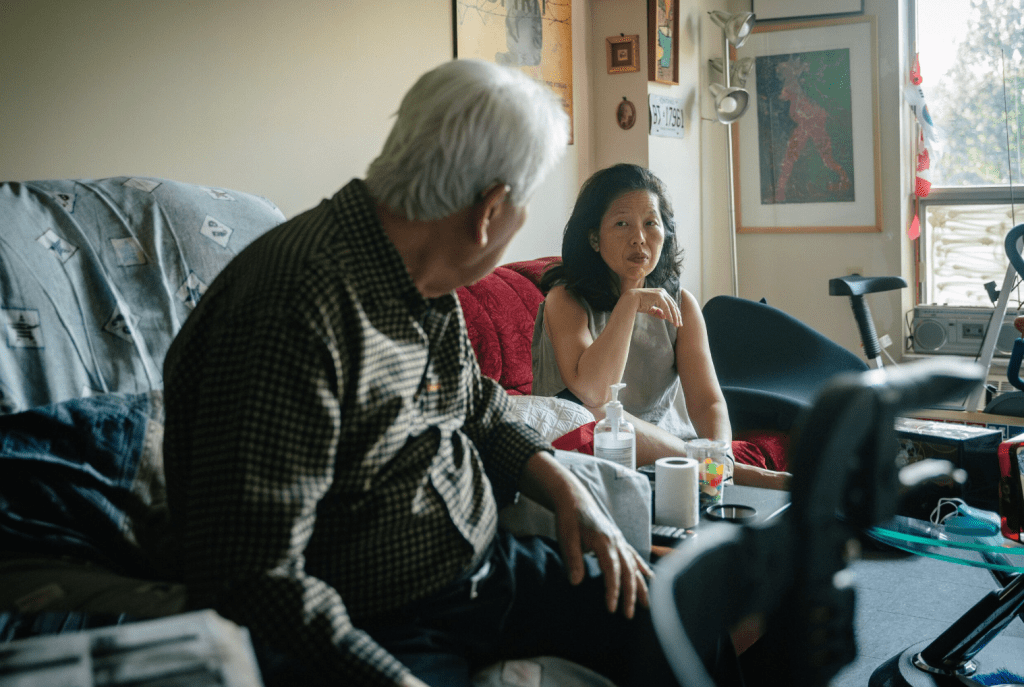
Min Sook Lee: There were a few reasons why I chose to do that. One was knowing that when you make documentaries with people, they trust you. It’s about relationships on-screen, but also off-screen. You translate trust into access, and you’re continually earning that trust. The workers featured in the films I made were putting their livelihoods on the line by speaking out, believing that if they told their stories, people would care and change would happen. I wanted to honour that.
One reason I turned the cameras on myself was to confront the question, “When are you going to take the risks that they did?” Our personal stories are not just private stories of personal struggle – our lives are constructed by the social conditions of our times. Taking a conscious, critical inventory of your life through that lens is a useful way to understand what happened. If you don’t know or don’t have a name for it, it’s hard to try to change those conditions.
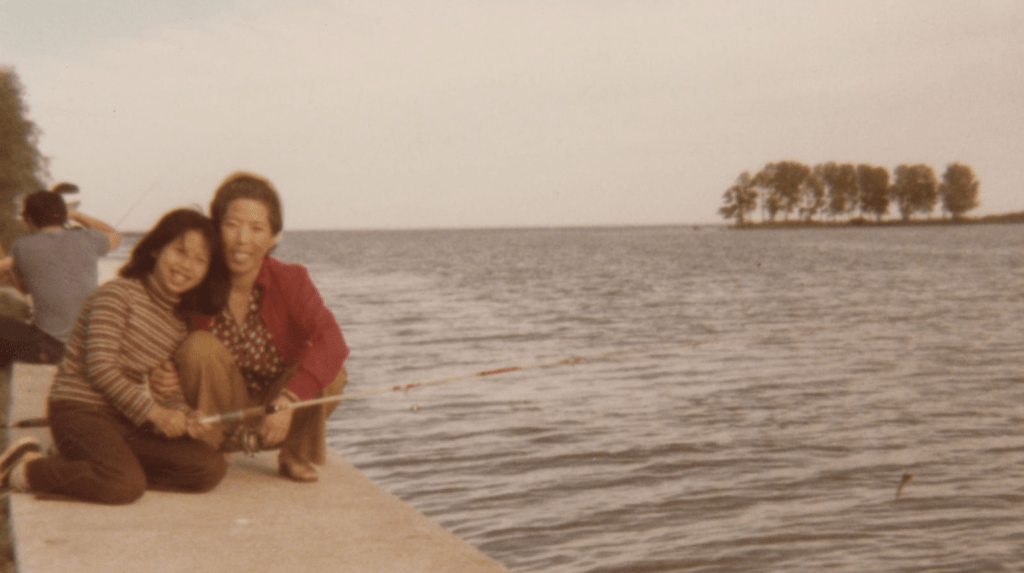
My mom died by suicide when I was 12, and I grew up in a family with a lot of domestic abuse and violence at home. My father was trained under a military dictatorship to be a violent person, and his job was to identify, root out and target people who were branded as communists in the military dictatorship of Korea in the 1960s. So that kind of experience at home is not private. It’s a collective experience because this is about a social order.
Often, when we talk about war, militarism, or dictatorships, we are referring to broader political narratives in the public sphere. We don’t really make the connection between how people who are socialized to be violent or to hurt other people carry that home, and how women partners or children are often the targets of that violence as well. With an equal force, but with a silence surrounding it, because it’s never named and it’s never talked about.
We’re living in a time of many international conflicts. I think that it’s equally important to talk about the public face of war, but also to recognize the way in which that violence is normalized and takes root in the most perverse ways in our own private lives. By not talking about it, we end up erasing the lives of people who have been hurt and then simply allowing it to go on.
My story is not that unique. A lot of people have grown up in homes of domestic violence, or with all kinds of pain. But I think what I can do as a filmmaker is make a connection between this private story, a part of my private story, and the political conditions that have formed the life that I lived.
There Are No Words is about militarism and dictatorship, the roots of Japanese colonialism and Western imperialism in Korea’s history, but the very fact that Korea has had a series of military dictatorships has formed generations of men, and then deeply informed the family structure and the intimate relationships people have in Korean society.
Korea has one of the highest rates of suicide in the world. It’s not because Korean people are uniquely suicidal. There’s something about the broader conditions in which Korea, as a country, contends with the forced division of North and South Korea, and the permanent war that seems to be accepted by most powers that be, this idea that Korea will never be at peace.
Those of us who are diasporic, like myself – I was born in Korea, but raised here – grew up in a vacuum in which this whole narrative that formed and shaped my parents’ lives was never spoken about by them or by the world that I grew up in. You grow up with a lot of silence, and you’re haunted by what we call “post memory”. It means you have a memory of something that didn’t happen in your life but did in your parents’ lives. Something that shaped and traumatized their lives. It’s not your memory, but it’s deeply shaped your life. All of these things deeply informed my film.
How can others help support the rights of filmmakers, documentary filmmakers and workers in Canada?
I’m a Member of the Documentary Organization of Canada (DOC), a really useful organization that advocates for policy change and supports doc filmmakers, and we’re one of the few left who do what we can to support independent storytelling in the country. And I’m also active in my faculty association at the university where I teach, trying to confront some of the very troubling privatization attempts by the province to turn universities from sites of learning into sites that basically produce factory workers. Chris Ramsaroop and my other friend, Evelyn Encalada Grez, co-founded Justice for Migrant Workers, a national organization. And now there’s the Migrant Workers Alliance for Change, along with many other organizations that operate in different regions across this country. Wherever you work, and if you’re part of something like the DGC, it’s so important to recognize that there is always going to be a class struggle and to build a sense of worker solidarity and identity.