Wider Lens sat down with DGC Ontario Production Designer John Dondertman and Location Managers Scott Alexander and Warner Strauss to talk about building the show’s central house, finding the right Toronto locations, and the close collaboration between the Art and Locations departments that helped bring it all together.
Season 2 of Adults is now streaming on Disney+.
What was the early process of creating the central house set, and how did that continue into Season 2?
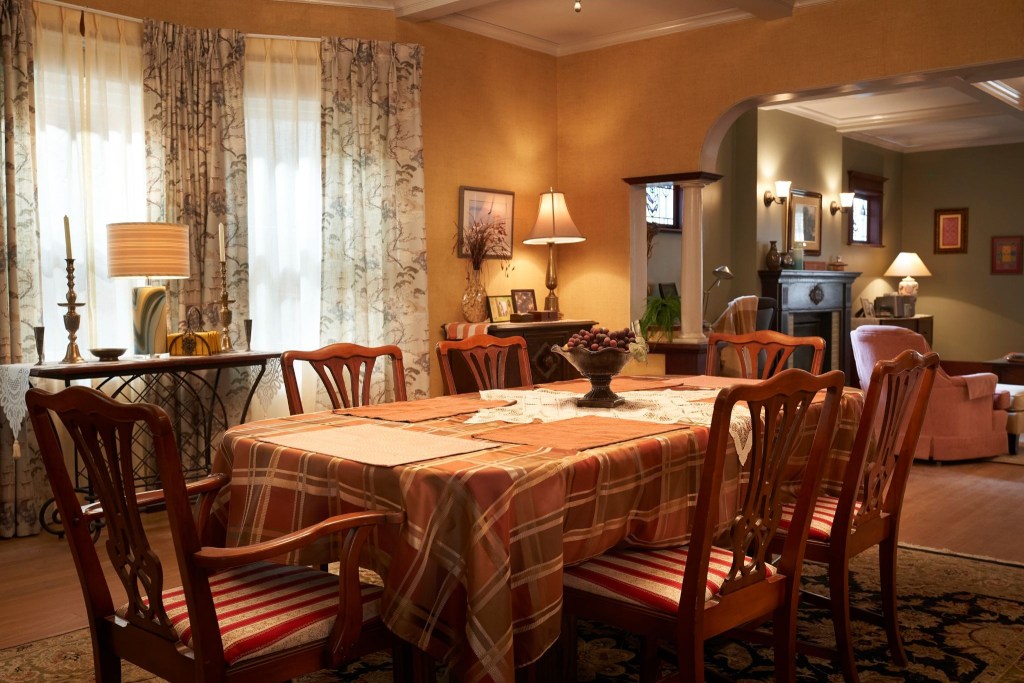
John: Production Designer Rocco Matteo shot the pilot in a real house, and I was later hired to design the series. Pilots are shot very quickly, with short prep times and a house was found that was much bigger on the exterior than the showrunners wanted because a more modest home would have been impossible to shoot in. For the series, we built the interior of Samir’s parents’ home in the studio based on the house shot in the pilot, but to accommodate a more modest home, I built a hybrid set based on a new, more modest exterior and the original interior.
The Showrunners, Ben Kronengold and Rebecca Shaw, are from Queens, and they picked something that looked like their grandmother’s house. They even used her house number on our set. The main floor was based on what they shot in the pilot, and I extrapolated from that and made it more camera-friendly. I designed the whole second floor. They were a little startled by the size of the set at first because they had been inside the real house. But I needed enough room for two cameras, two boom operators, the Director, and everybody else who has to fit into that space. You don’t really feel that extra size on camera, and in the end it worked out.

How did you use the house set to reflect the characters who live there?
John: One of the things they asked for was all the stuff you’d find around a house occupied by five 20-somethings: water bottles, hair elastics, cellphone chargers. The house is littered with it. The idea is that they’re living in their parents’ house while the parents are away on an extended trip. So their parents’ house exists underneath all the chaos these five 20-somethings have created. The characters are always switching bedrooms. The protagonist Samir has twin sisters we never meet, so there’s this pink bedroom that belongs to these teenage girls. A couple of the guys are sleeping in there, surrounded by all the paraphernalia sixteen-year-old girls would have on their walls. There are some kooky characters and funny situations, but the goal was to make it feel real and build up the layers of this family house underneath their lives.
Warner: And the cast was great. They were hilarious, riffing off each other, and the dialogue was very funny. The writers were amazing.
How do you make a built set feel lived-in while still allowing the production to move quickly?
John: When I design a set, it is an environment for the actors and camera to flow through. That’s the trick for me: making it not feel like a set. I tend to do a lot more stylized work, whereas this was very grounded and realistic. With a sitcom, you’re shooting eight or ten pages a day, so I made the set a little bigger than I otherwise would have. They have to move quickly and have both cameras in the room. They never want to take walls out. If we were taking walls out all the time, I could have made it smaller, but that would slow everything down. We also worked very closely with the Showrunners. It’s their first big series and very much their baby, so every detail is important.
Which parts of Toronto worked best for Queens, and how did you make sure the locations and sets aligned with the Showrunners’ vision?
Scott: One of the big challenges was matching Queens, Brooklyn and New York in Toronto. The showrunners and writers would have certain places in mind. They’d name a particular bar they knew and say, “This bar. We want something like this.” John and I would feverishly look it up, then set out to find something that could replicate it as closely as possible.
Warner: It could be a moving target because they knew these places incredibly well. They’d define an exact street corner and know exactly what they thought they were looking for. We’d show them something that closely matched what they originally described, and suddenly they’d say, “Maybe it’s more like this.” Meanwhile, our Location Scout, Jed Metzger, is out trying to find locations, and we have a huge folder full of clubs, cocktail bars, and all kinds of possibilities. Then the whole world changes and you have to go in a different direction. You just run in the new direction and do it with a smile.
John: Because the showrunners are from New York, they have a visceral reaction to whether something looks like New York or not. But what you see in a frame is often quite different from what you see with your eye. New York and Toronto work in sections, usually not in super-wide shots. Some sections of Toronto look quite a bit like Brooklyn or Queens. There’s a section of the Danforth, farther down and away from Greektown, that isn’t a bad match for some of the bigger streets in Queens.
Warner: Toronto is very good at playing eastern-seaboard cities. We can do Boston, Chicago, New York. There are little pockets of architecture throughout the city that can match New York, Queens and Brooklyn quite well. But there are architectural limitations, and sometimes there’s a scope and scale that we simply don’t have. It’s that sliver effect. If you frame it correctly, you can find it. And with advances in CG, you can extend the look.
Scott: One of the biggest banes for us is when someone says, “We need a big New York brownstone.” We just don’t have those in the same way.
John: Hamilton is actually better for Brooklyn and Queens in some ways. Toronto is so developed now, with brands and franchises everywhere. Hamilton has some of those wider boulevards and older streets. I also think the Junction is pretty good. That stretch of Dundas doesn’t have streetcar tracks, which helps.
Warner: Streetcar tracks are one of those giveaways. You’re suddenly saying, “Don’t pan down,” or putting a blocker car there so you’ll never see that little section of track.
What was one of the biggest challenges on this production, and how did your teams work together to resolve it?
John: One major thing last season was the snow. It was a Biblical winter. We had an exterior nightclub lineup scene in an alleyway with cast and background actors in miniskirts, and it was minus 30 with the wind chill. We had rows and rows of heaters just out of frame. Keeping everybody warm was a huge challenge.
Scott: And then there was the snow itself. We were literally hauling dump trucks full of snow out of neighbourhoods to get those exterior shots.
Warner: There are also these blowtorch-type tools that will melt the snow without quite burning the grass. It’s a whole process, especially when you’ve got homeowners standing at the window watching us do it.
John: In spite of all that, the Showrunners have been really happy shooting here. They seem to love the crews and shooting in Toronto. They emailed me recently to say how happy they were and how excited they are about the show.

What do you have to consider when finding a location for a show like Adults?
John: Fortunately, we had two very experienced Location Managers here who think this stuff through. A film crew has a huge footprint, so you want to be in a space that can accommodate that. They’re thinking about parking, lunchrooms and everything else that comes with bringing an entire crew into a location.
Scott: You also have to look at what’s actually happening in the script. With this show in particular, sometimes you have to be aware of what you’re bringing into a location because of what’s happening in the scene or what’s being said.
Warner: There’s some pretty spicy stuff in the show. That became a real issue for us. There was one scene where the characters were chasing down a friend’s mother, who worked in a Williams Sonoma-esque store. We approached Williams Sonoma and went quite far down the garden path. We were pretty far along when they decided there was a dirty word in the dialogue they didn’t want associated with their store. There weren’t going to be members of the public or store employees in the scene, but they didn’t want to be associated with that word, and the whole deal fell apart. Eventually we ended up talking to West Elm, who were much more receptive.
John: And this was only a few days before shooting.
Warner: Jed pulled another location out at the last minute. He did an incredible job. That’s the challenge. You have to be forthcoming about the dialogue and what happens in the scene while also explaining the context. We had something similar when we filmed at the all-girls private school Havergal. There was a particular line of dialogue that we had to modify a little bit to get into the location.
Scott: You have to be forthright, but you also have to smooth it over a little bit. You explain, “It’s going to be this, but it’s not going to be that bad.” You still tell them everything that’s going to happen.
Warner: There’s a little bit of jazz hands involved: “Don’t worry, it’s all fine.” But you have to get script approval from Locations. Sometimes if you read a line at face value, out of context from the rest of the script and the characters, it doesn’t seem funny. Then in context, it is funny. That’s the challenge.
John: And because it’s a comedy, so much revolves around the gag. Things can change quickly. We were prepping an episode in about four days, so unless Locations gets a good jump on finding things, that becomes very difficult.
Was there a location that was particularly difficult to find?
John: We spent I don’t know how long searching for an apartment for the first episode. They wanted a very specific exterior, which we found, but there was no usable interior there. Then we had to find an interior that could match it. We were constantly looking. Then the Director showed up and picked his place almost immediately. The funny thing is, we found it by accident. We were looking at the unit across the hall when the door to this other apartment opened, and it was perfect. It was the smallest apartment, but the Director was used to shooting in small spaces. A lot of Directors would simply say no, but he loved it. We turned it into this frat-boy-type apartment. There’s a scene where one guy is leaning over a sofa with his pants down while another guy is painting something on his butt.
Warner: And I had to describe this scene to the owner: “I swear to God, it’s going to be totally fine.” There was a realism to it because it felt like the real size of a New York apartment: very, very tiny. The Director said, “I want to shoot in a real place.” So we did.
John: We must have spent weeks looking for that apartment. Once the Director showed up, we had it in a day.
Warner: The funny thing was that the exterior they eventually chose was one of the very first places John and I showed them. We must have looked at at least 15 or 20 others. And that doesn’t include the places Jed scouted that we didn’t even bring forward. He churned through locations, knocked on doors and constantly brought us possibilities.

What might people not understand about the collaboration between Production Design and Locations?
John: For me, my Art Director is like my left-hand man, but Locations is equally important. Scouting is incredibly time-consuming. You don’t want to take the Director to three houses when you know two of them aren’t going to work. You can lose their trust quickly if you keep showing them things that aren’t what they asked for. I love working with guys like Scott and Warner because they understand the script and what the Director wants. If a Director says, “I need a window facing onto a church tower,” they’re going to beat the bushes and find the most specific thing imaginable. Over the years, I’ve realized how important that relationship is. When I take a job, I want to have a hand in hiring the Locations team.
Scott: It’s incredibly important that we work closely with John because we have to piece out the look of the project together. John collaborates with the Director and pulls that vision out of them. Then he supplies that vision to us, and we try to find exactly what it needs to work. We work very closely with Production Design to make sure everything is on point with what the Director and the show ultimately want.
Warner: It’s a very collaborative process. We’ll all get together and riff on ideas. We have huge databases that aren’t necessarily available online, built from our own experience and shows we’ve done over decades. You remember, “Five years ago, I shot this great apartment. Let’s see if it’s still around.” We’re constantly trading files, ideas and concepts back and forth, including with the Scouts. Then we bounce those ideas off John and the Art Director. It becomes this very fluid process, and it’s rewarding because it’s so creative.