From the perspective of two filmmakers from across Canada with different yet similar career paths, Gillian McKercher (DGC Alberta Member, CFC Director’s Lab ‘19) and Karen Chapman (DGC Ontario Member, CFC Director’s Lab ‘18) discuss finding their voices as filmmakers at the CFC and further honing them at the DGC, navigating burnout, motherhood, and systemic barriers, and how organizations and communities can ensure that no filmmaker feels alone in their journey. Co-presented by the Canadian Film Centre and DGC Ontario.
Gillian’s new film Lucky Star screened at TIFF Lightbox on May 16 with a streaming release to follow. See Karen’s most recent film Village Keeper in select theatres and streaming on Crave.

L-R: Directors Gillian McKercher and Karen Chapman
What first drew each of you to directing, and how did that passion evolve into pursuing the CFC Directors Lab?
Gillian McKercher: I’m a writer, director, and producer based in Calgary. I studied chemical engineering and worked in the oil and gas industry for a few years, but I had this deep sense of disconnection. I called it “career dysphoria.” No one in my family was in the arts, and especially in Calgary, it felt like filmmaking was an impossibility. Still, in 2016, I decided to take the leap and pursue film full time. I made my first micro-budget feature, Circle of Steel, through a grant from the Calgary Film Centre. Around that time, I also worked at the Calgary International Film Festival and started my own company, Kinosum Productions. After that, I applied to the CFC Directors Lab because I needed to grow, and I needed to find my people. I used Circle of Steel to apply and got in the year after Karen, and that’s where I developed Lucky Star.
Karen Chapman: I always knew I was a storyteller, but I had no idea how to make a career out of it. I worked many jobs from life insurance to bartending to support both my family and my films. Eventually, I studied documentary at Emily Carr in Vancouver and kept creating. I applied to the CFC many, many times and didn’t get in. I made a short doc that aired on CBC Docs, but at that point, I had a one-year-old and it didn’t feel fiscally responsible. It felt like a pipe dream instead of a career so I quit. That’s when Charles Officer suggested that I apply again and so I applied to the CFC one last time, I also applied for Telefilm’s Talent to Watch Program with a script for Village Keeper and a few other grants and then started applying to customer service jobs and moved on with my life. And then I received word that I got into the CFC, got Talent to Watch funding and every single other grant. Through this process, I learned not to give up.
What were some of the biggest lessons or revelations you took away from your time at the CFC?
Gillian: The CFC really changed everything for me. It felt like the first step towards entering the larger Canadian film community. There was this idea that if you were serious about being a filmmaker, you did a Toronto stint. I had been volunteering at artist-run centres, making things happen in Calgary, but I knew I needed that next level of support. When I got into the CFC, I immediately felt this pressure to prove myself. Cinema Scope Magazine was a big deal at the time, and I was reading that to study, thinking everyone in the program would be this huge cinephile. But everyone was way more relaxed than that, so it was great. It was a very positive experience for me to go and to know that I belong to this community that was broader than just the wonderful Calgary community.
Karen: There were so many lessons from my time at the CFC. But the skill that I’m constantly using is my voice. CFC really emphasized a sense of clarity and specificity for creating and expressing my vision. But that lesson was hard-earned. There were many challenges.
When I did finally get into the CFC, there were veiled and outright comments from peers — like “Oh, you got in because you checked all the boxes”. At the time, I was one of three Black women who had ever come through the directing program and it was a difficult space to navigate. But being immersed in craft and clarity of voice was a driving force. Studying the work of folks like Clement Virgo, Patricia Rozema, Charles Officer and Norman Jewson became a North Star for what the possibilities could be.
I remember clearly watching the faces of my family members becoming engulfed in movies like Fiddler on the Roof or Guess Who’s Coming to Dinner and seeing them engaged in these characters’ stories. Storytelling felt like magic that I had to understand. I actually lived in a housing project that was maybe eight minutes from the Film Centre. So I would pass by it all the time, and I would think, “Wow, what if I could go there? Everything could be different, I’d somehow be different.”
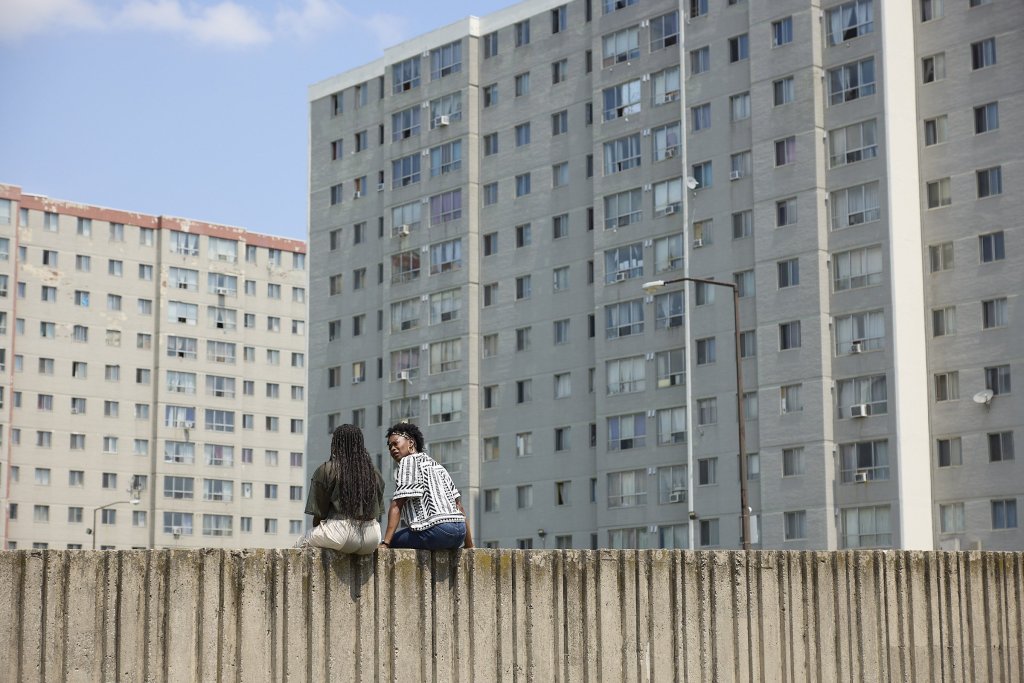
Village Keeper (2024), directed by Karen Chapman
Gillian: I was still very much in that space of trying to prove something. I had this weird idea of what a filmmaker should be, and so I tried to be that. But once I got to the CFC, I realized that people just wanted to make great work and learn from each other. I brought this urgency, like I had to make everything happen right away, and it all had to be perfect, and the CFC gave me a chance to slow down and actually think about what I wanted to say.
How did participating in the CFC Directors Lab shape the way you approach projects today? How do you think your voices as Directors have changed since?
Karen: I stopped apologizing for how I work. Being a mom, being older, being a Black woman, I used to try to fit into spaces by hiding. Now I bring them with me. I’d spent so much time just trying to get work done that I hadn’t had the luxury to sit with those deeper questions: What am I trying to say? What kind of storyteller am I? The CFC gave me space to explore those questions and to do so while actively making something.
I had some really hard moments during the program. In one of the exercises, I was paired with an actor who ended up being really difficult, particularly toward a Black actor I’d cast in the scene. I tried to be professional, to redirect, but it got to a point where I had to just finish the shoot and move on. It was one of the hardest things I’ve ever done. But I did it. I left the set and cried in my car, but I got through it. And what came out of it was the short that inspired Village Keeper. I didn’t think that short would go anywhere; I just needed to get it out of my system. But it ended up at TIFF, then the Golden Globes, then released theatrically. That whole experience showed me what I’m capable of when things go wrong.
Gillian: The CFC was the first time I was in a creative environment where people saw me as a Director, not just someone making films, but someone with a voice. I came in with a lot of internalized pressure to be taken seriously. But I found that once I let go of that, I was able to connect more with my work and with the people around me. I got to experiment, take risks, and that’s where Lucky Star really started to take shape.

The CFC Directors Lab is often a launching point for Directors stepping into bigger, more ambitious projects. How has becoming a DGC Member helped you continue that growth and take your work to the next level?
Gillian: I’m excited by the opportunities which are afforded to me now that I’m in a unionized position, but I’m also connected to the Calgary film community at large. I really think that community is imperative in all aspects of life. The world can be very unstable, but if you invest in your community, it will be there for you. It helps to remember why you’re in this in the first place, which for me is a love of story. It’s a love of connection to the audience when you’re watching and experiencing, and feeling together. I really think, as a union member, there’s no one I know who’s gotten this far who doesn’t truly love it. If you don’t love it, you’re not going to last. I think that love connects me to the broader community, as well as the folks I’ve met on the union side of things.
Karen: For a long time I felt like an island. It’s taken a really long time, but one day I turned around and found myself a part of a beautiful community of doc and in narrative, and even interactive filmmakers. So much feels uncertain right now, but it makes me feel braver now that I’m doing it alone. With the DGC I have allies from coast to coast, people or organizations that I can call and they can call me and we support one another. And that’s not nothing. Whenever I have the opportunity to do an interview or a panel, or talk to youth filmmakers, I always say yes if I can, because I realized that so many people helped me. I just feel this incredible sense of service, to give back.
What advice would you give to emerging Directors who are thinking about applying to programs like the CFC?
Gillian: This is a punishing art form. Whether you call it an industry or a creative practice, filmmaking can be incredibly tough: emotionally, psychologically, financially. Seeing a film get distribution in Canada is a huge accomplishment, but that doesn’t show the years of rejection, self-doubt, and 3 a.m. breakdowns when you’ve been turned down from yet another program.
So my advice is to know that all of that struggle is, unfortunately, part of the process, especially for folks from marginalized or underrepresented communities. If you’re feeling like you don’t belong or you’re constantly up against something, you’re not alone. Everyone’s challenges will be different. What a trans filmmaker experiences might differ from what a cis woman experiences. But the core truth remains: this work is hard. Programs like the CFC can be transformative, but they are just one part of a long journey. Find your community and the people who will support your voice.
I think when you’re young, you feel pretty invincible. The power of the self can take you really far. This sort of irrepressible ambition is really attractive, and everybody’s trying to bottle that. But just in my experience, personally, that individualistic drive can flame out if you go too hard. And as you mature, you realize that your community and being supported by other people create longevity in an artistic practice. If you want to stay in the industry past 29, you have to cultivate these sincere relationships with other people.
Karen: My advice is to show up and support others, becoming a part of a like-minded community of artists who share your ethos will show up tenfold down the line. We are our own rescue.
There’s a real sustaining factor in how we support each other. It’s not lip service, it’s genuine, especially for women. I think moving past this sense of individualism is important, particularly in Canada, because we do thrive on community. I think moving past archaic, patriarchal ideas like there can only be “one” or the “best” is really important. And as a mother, that’s a whole new set of challenges. Making a film while pregnant, I didn’t tell anyone until I was already on set. I was afraid people would assume I couldn’t do the work. And I know I’m not the only one. So many women storytellers step away from directing because the support just isn’t there, so I’m always thinking of ways to support women.
When I was coming up, there were more funding opportunities, like BravoFACT, that helped emerging artists build their body of work. Those resources are disappearing. People say, ‘just shoot on your phone,’ and sure, you can. But to get to a professional level where you’re a member of a guild like the DGC, you need real opportunities to train, experiment, and grow.
Gillian: To speak to your earlier point, I didn’t take maternity leave because I’m self-employed as a filmmaker, and this can be a very volatile industry. So I was also working while pregnant, fully with both of my children, and I was working immediately afterwards, doing grant applications two weeks after giving birth. So it’s sort of like an extreme sport, where if you want to do filmmaking, it’s already extreme, and then you want to be a mom, and it’s even more intense. But I think, to be a good director, you need to experience life however you choose. And for me, I knew I wanted to have children, and I feel like that’s what makes my voice and my approach unique, and Karen has her own unique experiences, too. So when you work with us and you see our work, we’re bringing something different, other life experiences that metaphysically impact our films.
Karen: It is absolutely an extreme sport.
I’d met filmmakers like Trish Dolman when I was working in Vancouver for her company Screen Sirens, and she just had a baby. She brought the baby in, and she used one of her production offices as a nursery. I didn’t have kids at the time, but it planted this seed of possibility in me. When you want to see something, you see it all the time. So I kept looking for and seeing people who worked around their lives somehow, and so that was the goal I kept reaching for: to live my life without asking for permission while also making work I’m proud of.
I think we made six films in six months at the CFC; the schedule was challenging. I’d sit my daughter on the floor of the editing room in the CFC cabins while working and realize this was going to be my way forward. And because I found models before me, it felt possible.