Aleks sits down with Wider Lens to discuss her experience making this ambitious film, the thrill of building worlds for this infamous cast of characters to inhabit, and why collaborating with her Toronto production family made The Apprentice such a rewarding creative process.
Can you tell us about how you got your start in the film industry?
Aleks Marinkovich: I initially studied architecture in England. I was in my 20s, and I decided I belonged in Europe. So off I went, like every 21-year-old. I returned to Canada in the mid-90s when there was a massive recession and no work for architects. The late, lovely Arv Greywal was a good friend at the time, and he got a job in film through connections. When I learned about the film industry, I was like, “Whoa, they feed you!?” Slowly, I ended up getting my first apprentice gig, which was Detroit Rock City.
So then I fell in love with it, creating these magical worlds of different realities and being able to meld all sorts of images and tech. It was like photography on a three-dimensional scale. For years, I worked my way up the chain. I ended up working with Dennis Davenport, who was my main art director for several years, and then slowly climbed the ranks and eventually got my first art directing gig with Tamara Deverell on Firehouse Dog. I went back and forth between art directing and set design because I wanted to work with nice people. The hours were long, and it was really important to collaborate well, constantly learn and have fun. These people become your family over a 12 to 16-hour day, and being around the right people was very important to me.
How did you come aboard The Apprentice as a Production Designer?
Aleks Marinkovich: Through the years, as I was art directing, every so often, I’d get people like Dan Bekerman and other young producers reaching out to me to ask if I wanted to do Production Design. I was like, “No, I’m happy being an Art Director.” It wasn’t something I wanted to pursue because I was pretty busy and happy at my job. So, I turned down some opportunities stupidly. Through Dan Bekerman, The Apprentice came to me and some friends of mine, Producer Greg Denny and Kari Measham, who’s a Set Decorator with IATSE, a year before. Still, we were waiting on another project, but it came around full circle and a year later, Greg decided to come on The Apprentice as an Executive Producer. And then he was like, “Aleks, why don’t you design?” I said, “Send me the script, and we’ll see.” Greg sends me the script, and it’s bloody brilliant. Who would have thought they could make this movie about Trump that’s so interesting? So I went and interviewed, put together a package with my trusted friends, Michaela Cheyne and John Moran, and had a great interview with Ali Abbasi, the Director. Still, they wanted to get a designer with bigger credit at the time. Of course, I was like, well, then you should reach out to Matthew Davies and Phillip Barker. Matthew ended up getting it. They’re scouting for six weeks, and then all of a sudden, Matthew is slated to work on Star Trek. They gave him the green light to go do this little movie, but the producers on that show wanted to start now. I love Matthew. I’ve worked with him, and we’re very like-minded. So, when they talked about who should take over for Matthew, they convinced me. Matthew’s a very good salesman! Art Director Michaela Cheyne was also signed up, and she is one of the best that I know and love to work with. We’ve collaborated on other shows like American Gods. So I thought, “Okay, Michaela is with me, and I can get this art department together.”
What was your process like working on this film with such a tight timeline and budget that you’d just been brought on?
Aleks Marinkovich: So Matthew walks away. We have about a week of overlap. Ali and Screenwriter Gabriel Sherman had this project on their minds for quite a while, so they had already made the movie in their heads. The problem was that this movie is a period piece that spans the 70s and 80s, and you couldn’t recreate that on our budget, even if it was just trying to create the essence of Trump. When I gave my presentation to Ali, I saw it in three acts, and that’s how they filmed the movie. I was really excited when I saw it at Cannes because they did film it that way. When you’re in the process, and you’re just going day to day to get things done and try to deliver as much as you can, it is hard to see the stylism come through. But it was really difficult, and if it hadn’t been for my amazing Art Department and Graphic Designers, John Moran, Theresa Shain and Jon Hunter, I think we would have been dead because we had so much to create. We also started to lose locations because word started to get r out that this was a movie about Trump, and some people didn’t want anything to do with us. They found some great locations that could solve a problem of three different set pieces, and then we lost it, and we had to start again. At one point, we were even looking at building something, but there was no way we could afford to do the build and then have the visual effects that we needed to create Manhattan. It was like, “How do we create this world?” We kind of tried to get realistic. At one point, I was like, “You know what? This is ridiculous. We don’t have the money. We’re not doing a documentary here; we’re doing a docu-drama. Let’s get back to the essence of his world and go that route rather than try and create everything hyper-realistically.” The club and the triplex were difficult stumping blocks for us and creating a casino with no money. We wouldn’t have been able to do it without Set Decorator Jaro Dick and his team, and we were so lucky to have them on board. He called in favours, and it was the strike, so people were willing to help us. We were lucky that the Toronto Film community and our suppliers came to the rescue, so people were happy to help. It was truly a collaboration. Joel Hay (1st AD), Richard Hughes (Location Manager), and I were constantly having meetings, trying to figure out how to give Ali and Gabe the best that we could, considering the huge limitations we had. We wanted to do good by the script because Gabe wrote a really interesting script and was telling the tale in a way that needed to be said properly. You wanted the characters to feel comfortable in those set pieces and feel that they were living the moment right in the production design. It becomes like a third character in the scene.
There’s so much archival material from this time period, as well as footage of Trump throughout the years. What is your research process for a period film like this, and how do you sort through all that material and distill it into what’s most important for the film?
Aleks Marinkovich: When I first started researching the film, I saw it as three acts. It starts with Trump being this daddy’s boy in his naive little world. I ended up looking at photography and images that were evocative of that time in the 70s and the innocence of Trump in his world. So Kasper Tuxen, the DP, who is an artist, and the Visual Effects Supervisor Matt Whelan and Ali tried to emulate or create different acts within the film. The basic looks decided for filming in the end were 16mm for the ’70s and broadcast video for the 80’s, with minimal “for camera” lighting. Essentially, the aim was to make things not look too pretty and show the grit of that moment in time.
We went through this rabbit hole of trying to find stock footage that would be clean to seamlessly be used in the film because we had so little money and to recreate New York exteriors, which I love doing; there are so many layers, so we couldn’t do that. The only place that we had an opportunity, and it was limited, again, because of location restrictions, was in front of the Royal York, the Commodore exterior, which was a combination of real set pieces and not painting what we couldn’t achieve for various reasons. In the end, when I saw the final film, they used real rough-cut video that wasn’t perfect and put it in the movie. It looked great. You want that grittiness, right? You want to get that gritty feel of New York at the time and put Trump in it, and even though it’s kind of warm and fuzzy, there’s a grit to it. They managed to do that, and the Editors did an amazing job.
The second act is when Trump meets Roy Cohn. To me, it felt like David Lynch’s Blue Velvet. There’s a tonal change in Blue Velvet – right at the beginning, everything’s all happy, and then suddenly, we’re at the club, and everything changes. So when Trump moved on, we started to get away from the warm fuzzies. The pictures I found in my research emphasized the Roy Cohn of it all: this harsher, jaded, cooler, meaner world, and Trump gets enveloped in that. I found street images from the millions of books I have on New York in the 70s, and then suddenly, you’re into the 80s. Lighting is harsher. People don’t look so good on film. The film becomes cooler and cooler until the final Trump iteration: The opening of Trump Tower.
How do you manage to be so flexible and adaptable when you’re making such an ambitious film on a tight budget?
Aleks Marinkovich: Trump Tower was another really hard thing to create. We lost the location at the last minute and didn’t even have a proper full construction crew. We had one lovely man, Brett Hayward, and the Star Trek guys helped us a lot, like Kevin McCullough. Frank Siracusa had given us the blessing to use their shop because they hadn’t started up yet. So Kevin McCullough, who was helping us out with his guys, Paul Jefferson and Clinton, had scenic help coming in to go on the tech survey. It was nuts, and then suddenly, Star Trek started up sooner than we had anticipated, so these guys had to walk away. I ended up getting this lovely Carpenter, Fred Hayward, who works with these guys, and Jameson Curry, who does The Handmaid’s Tale, and his trusty sidekick, Adam Adderton. These guys came in, and luckily, Chris Hatcher allowed us to use the paint shop from The Madness. That’s how crazy this was.
Michaela had this saying: “We’re not here for a long time, but a good time.” It’s a triumph song, our department mantra, and it kept us going. Ali kept saying, “This is punk rock, baby,” and I said, “Yeah, absolutely, let’s be punk rock.” So let’s suspend the reality of what was truly the world for real and create our own Trump world. Everyone just brought what they could to the table. There were a lot of expectations, and again, we didn’t want to get things wrong. Every day, there’d be a new ask or something to change. Richard Hughes then came in with the perfect disposition. He and Michaela never got rattled. You need those cheerleaders to say, “We can do this.” Greg Denny is a good friend of mine, and we had our battles because being a producer is difficult. I don’t even know how Matt Whelan ended up finishing the film the way he did because they had to deal with all the stuff that we couldn’t physically do that normally I would have done, you know, which has changed. Street signs and billboards had to be created seamlessly, using visual effects on a shoestring budget to help create this kind of world.
Are there any sets or setpieces you’re especially proud your team was able to pull off?
Aleks Marinkovich: I was really happy with the club. And Mar-A-Lago was another one that I was pretty happy with, considering we shot it in December, and it was really cold. We filmed at the Bickle Estate, and it was a lovely place. Still, it was falling apart, so it was hard to make it glamorous, but we pulled it off. The club I was excited about because, to me, that was the most interesting part of the movie. It’s where Donald meets Roy, and it had to have a feel of mystery and intrigue. We ended up shooting it at Piano Piano. Casper and Ali were like, “I don’t know, Aleks, I don’t know.” And I’m like, “We can do it, guys, we could do this.” And I think that turned out well and gave a nice palette for the characters to inhabit. The other amazing thing was at the end doing Trump Tower. We basically had a week, because we lost a location, to try to create vignettes within this space that didn’t look like Trump Tower. We had to bring in specific, tiny little set pieces because we didn’t have access to the building till six o’clock, and then they had to prep and shoot. So basically, our little army was coming in to set up these little vignettes that they could film. It was something that we were all dealing with from the beginning of the film, and we kept pushing off because it was like, how do we do this? We can’t shoot at Trump Tower. We even considered going to the real Trump Tower in New York and filming there. In the end, they were happy, and it looked pretty groovy on screen.
I can’t forget Roy’s townhouse; that turned out really groovy, too. It was a great house that we had on Wellesley, and Set Decorator Jaro Dick and his team came in to set it up. Recreating Roy’s bedroom was fun, as was finding all those frogs. He was obsessed with frogs and had a huge stuffed frog collection. Roy Cohn was such a strange, bizarre man. His bedroom was like a sex den but very childlike. He had this four-poster bed with a mirror because he was addicted to sex but closeted. There was also this weird wallpaper that 1st Assistant Art Director Theresa Shain recreated. We built this world that encapsulated Roy, and it worked out really well.
What’s next for you? As someone who is typically an Art Director, would you take up the challenge of Production Designing again?
Aleks Marinkovich: I would, but I’m truly picky. I can’t do television. It’s a lot. After American Gods, I did two or three series, but it’s just too crazy. It’s like doing a feature film every week. Features are more fun to me, and there’s an arc to them and an ending. It’s nice to be on one of those big shows that go on for ten months, but at this point, I don’t have it in me. I would love to Production Design another character-driven movie. What excites me is creating these environments and atmospheres to be part of the creative process, not just logistically, but being able to help the director get to where they need to be. I’d love to work with Dan Bekerman again because he brings such interesting projects to Canada, and I’m thankful he always reaches out to me.
Being that it was my first proper production design job, knowing that I walked away from so many other production design opportunities in the past, I was like, “Fuck. Why did I say no to this before?” I’ve helped other friends and pushed them forward, and colleagues who were my apprentices once are now Production Designers, like Britt Doughty, and I’m so proud of them. I stood back for a long time, and doing this in the twilight part of my career, because I’ve been at it for almost 30 years, has felt really good. So much of the community came out to help, and it was fun to be with these like-minded people who became your family after enough projects to be there. I’m so proud of what we accomplished. 52 locations and 83 sets…it still amazes me that we pulled that off in 32 days!
It truly was a real collaboration.
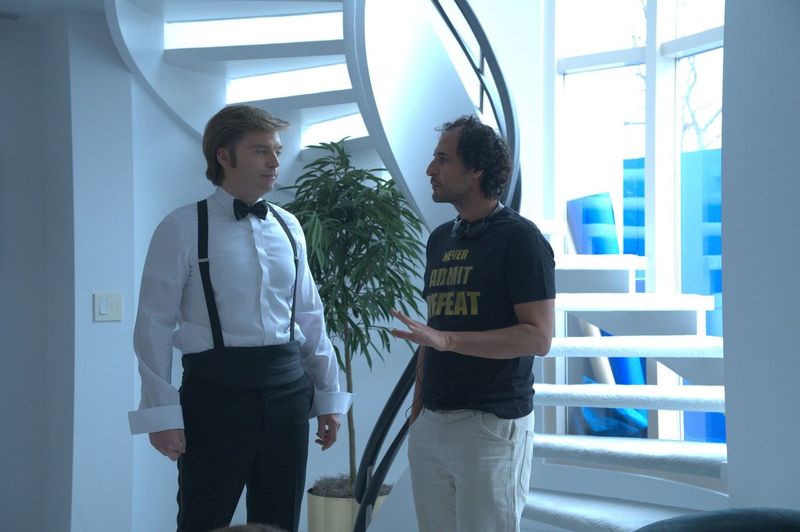
Director Ali Abbasi with Actor Sebastian Stan (Donald Trump) at Trump’s apartment set
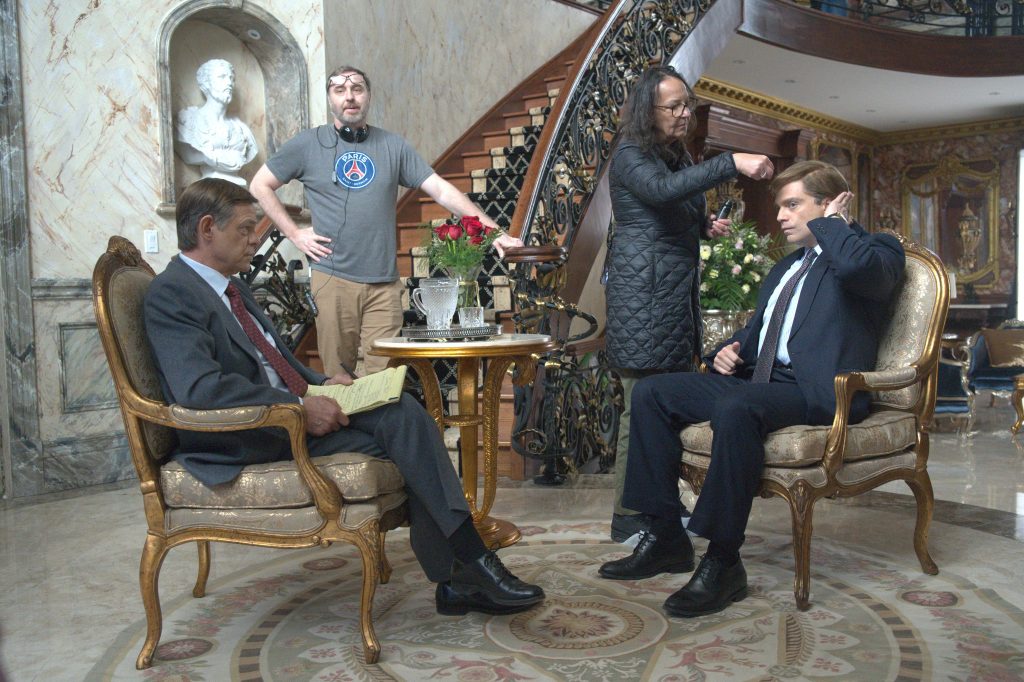
Setting up a scene at the country club
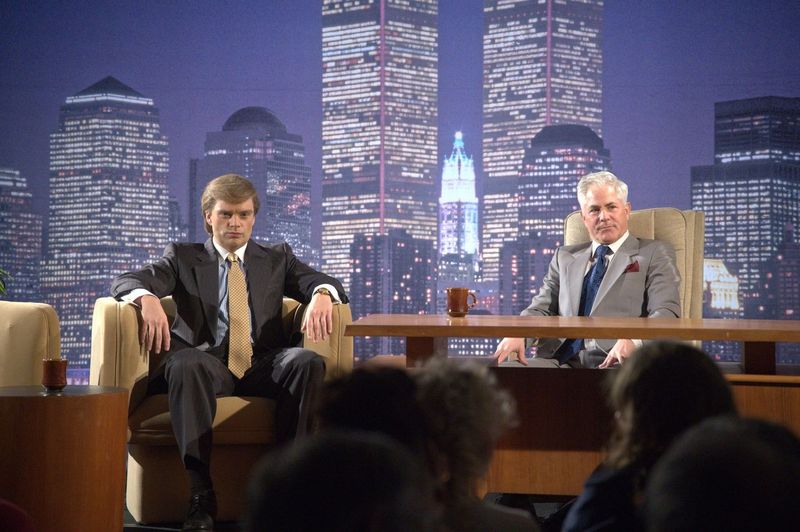
Setting up an interview with Dan Rather at Trump’s triplex apartment.
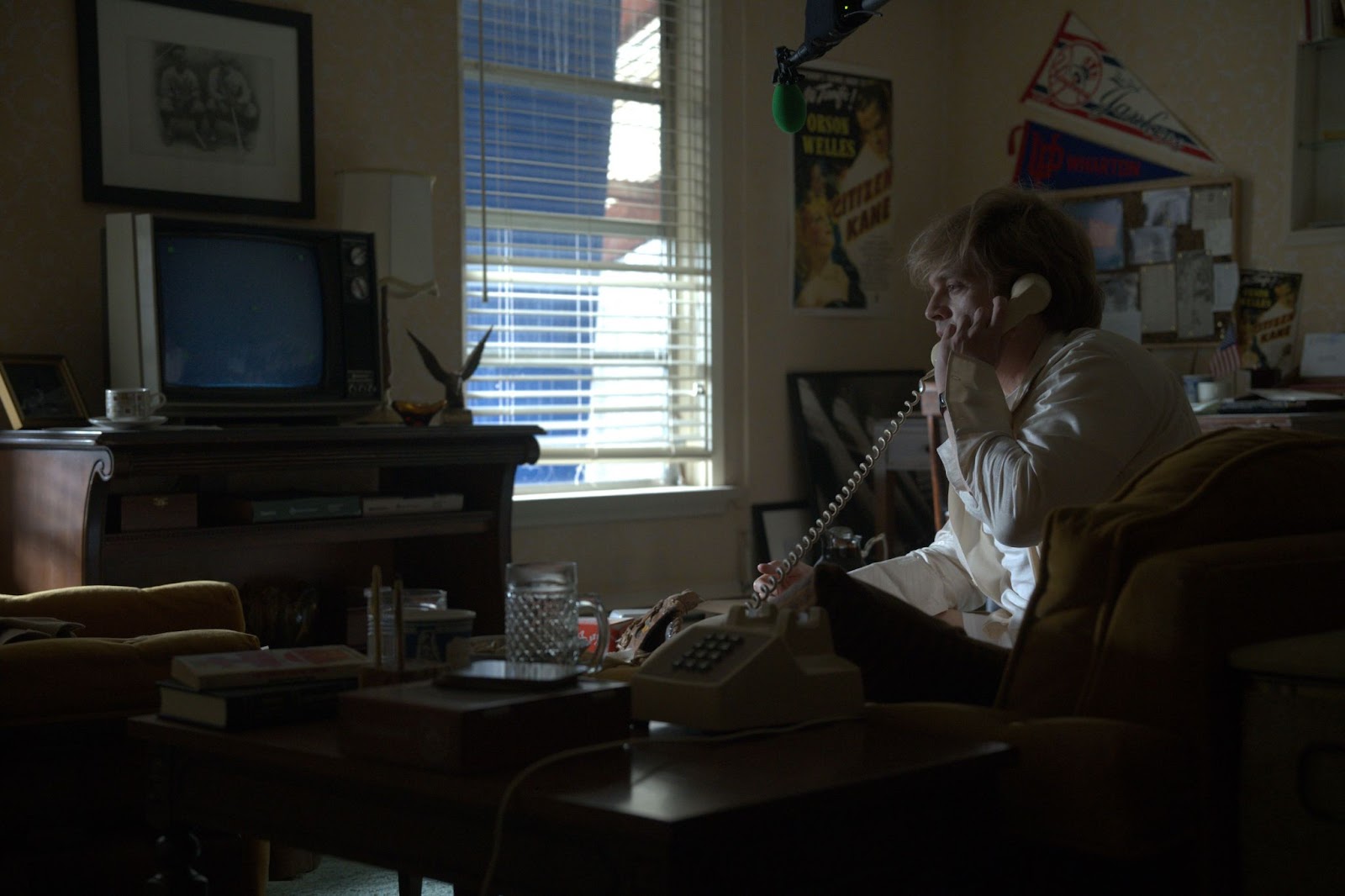
Trump’s first office set

Roy Cohn (Jeremy Strong) at the casino


Previs of the exterior of the Commodore. Aleks Marinkovich: “This was for the opening of the movie and really our only chance to properly dress an exterior. We had help from VFX to fix unwanted unmovable construction, signage and add flags.”