In this conversation with Wider Lens, Sturla Gunnarsson discusses the power of honest storytelling, the complexities of capturing history as it unfolds, and why Final Offer continues to resonate forty years later in today’s climate of trade tensions and national identity.
The 40th anniversary screening of Final Offer will take place at the Hot Docs Theatre on Sunday, October 5th, at 2:30 PM, followed by a Q&A featuring Sturla Gunnarson, Unifor National President Lana Payne, and President of Unifor Local 200 in Windsor John D’Agnolo, moderated by Arden R. Ryshpan. Reserve a free ticket here.
Forty years on, what still feels relevant to you about Final Offer when looking at it through the lens of today?
Sturla Gunnarsson: The film is about a Canadian union taking on the full might of America’s most powerful corporation, while simultaneously confronting the leadership of their own union—and winning. People have described it as our last great nationalist drama because a year after the film was finished, Canada signed the free trade agreement, then NAFTA, then the Canada-United States-Mexico Agreement, and it led to ever-increasing economic and cultural integration with the U.S. Now, 40 years later, we’re at another inflection point. The trade wars have exposed our vulnerabilities, and we’re called on to stand up for ourselves as a nation – the whole “elbows up” movement we’re seeing today. I think Final Offer has an uncanny kind of resonance in this historical moment. It feels like it’s come around full circle.
Some audience members at this screening may be seeing the film for the first time. What do you hope they take back to their own organizing rooms and workplaces?
SG: I once asked Bob White, the head of the Canadian sector of the Auto Workers Union and the hero of the film, how he maintained his confidence in the face of such a formidable adversary. And he said, “Look, I spend 90% of my time thinking about them. They spend 10% of their time thinking about me.” The takeaway there is to be more prepared than the other side, have a unifying message, understand your historical moment, and be brave.

As a Director, how did you work to turn complex bargaining discussions into something cinematic, and how can filmmakers use those and other strategies to build support for Canadian workers?
SG: We never actually set out to make a film that supports Canadian workers. We were sympathetic to the autoworkers, but our goal was to tell an honest story. Audiences can tell if a film is truthful, and they know if it’s not engaging; if you fail on those counts, you’re not helping anybody. You need to embrace the complexity of the characters and the situation, let the story unfold on its own terms, and portray the characters as they are, warts and all.
From a filmmaking standpoint, if you look at it in retrospect, the dramatic premise is kind of a no-brainer: the charismatic union leader takes on the chairman of America’s most powerful corporation, is betrayed by his own president, takes his membership out on a strike that cripples North American manufacturing – and he wins. That’s a hell of a story. Our big challenge was that we didn’t know any of this was going to happen at the start. We began by making a documentary about collective bargaining in the auto industry, and the story that evolved was a gift from the documentary gods. We had the good sense and the financial backing to follow it.
Our Editor, Jeff Warren, distilled the story from over 80 hours of footage into a 90-minute documentary thriller. Technically, one of the biggest challenges was the dialogue; it’s all very internal. You need to understand the collective agreement, the history, the issues, and the acronyms to follow the drama. Sometimes it felt like they were all speaking a foreign language, so it took a long time and hard work to distill a narrative that delivered the essential information at the right moment.
Cinematically, we were quite influenced by Gord Willis and The Godfather. We had these big, burly guys with English, Irish and Scottish last names, smoking cigars and pounding tables. The lighting was very minimally intrusive but dramatic – we called it “The Godfather lighting.” That was our cinematic reference point, but I think the key was having the ability to understand the story as it was taking shape, and to let go of previous ideas to embrace what was right in front of our eyes.
Was it difficult to secure access to some of these backroom conversations while you were filming?
SG: We spent the better part of a year negotiating access with the company and the union. A year before the strike, we spent a lot of time with them, creating a sense of trust on both sides. We weren’t telling one side one thing and the other side another.
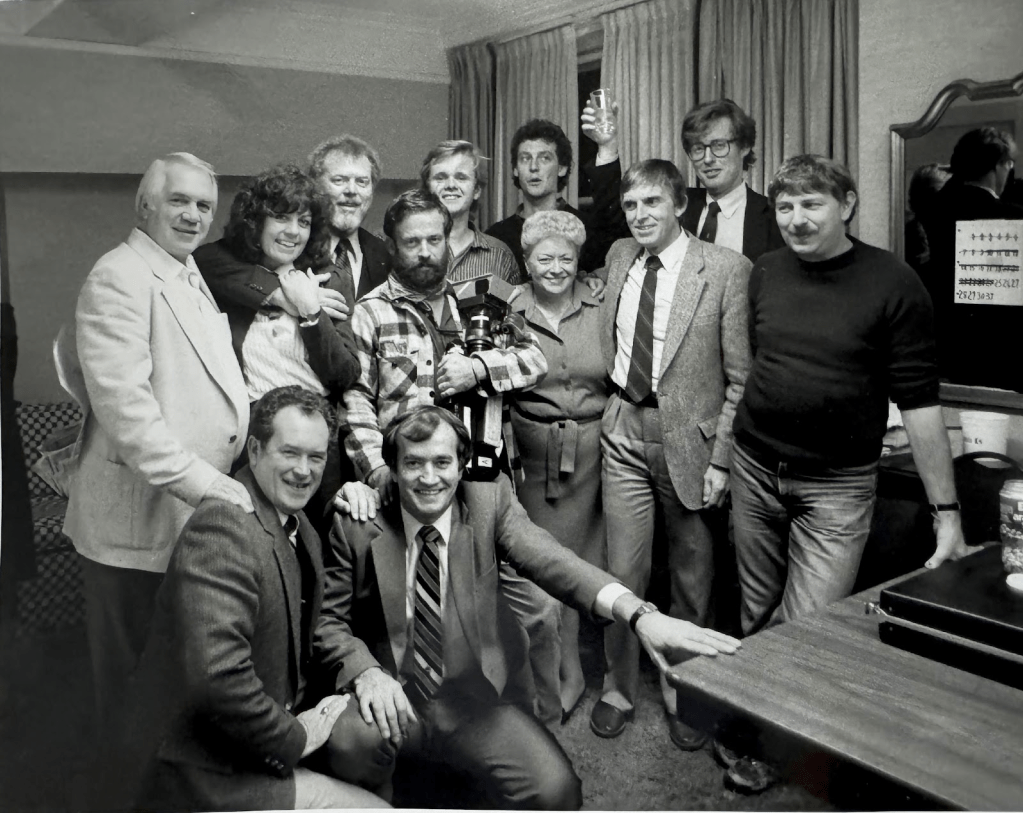
In documentary filmmaking, access is a constantly moving target. People say, “Yes, you can have access,” and then you get there and it’s more like, “Well, you can have access to that, but maybe not this.” The big turning point for us was the morning after Bob White realized he’d been betrayed by the American union, and he was about to make his next move. I remember he turned to us and said, “Just so you guys understand this, this really is the end of the International Union.” He knew this was a historic moment, and he wanted it documented. Access became a lot easier at that point. We spent weeks on this workstation on the shop floor in Oshawa, and that was because the President of GM Canada wrote us a note giving us permission to go. He had thought we would go for a day or two, but we went for weeks, and nobody questioned us because we had that letter.
The screening is followed by a conversation about Canadian sovereignty in the age of trade wars. From your perspective, what’s the message in Final Offer about keeping decision-making local?
SG: The central conflict in the film is between an American corporation determined to impose a one-size-fits-all American contract on Canadian workers and a Canadian union leadership saying, “We live in a sovereign country. We have a different culture, history, and economics, and we want that reflected in our collective agreement”, and they were willing to fight for it. I think that’s the message: we sometimes have to fight to assert ourselves and our own national sovereignty.
We’re currently living through a time of trade wars and cross-border pressure. How do Canadian unions collaborate with other international organizations while continuing to protect and serve our workers in Ontario and across Canada?
SG: I think it’s fair to say that solidarity sometimes stops at the border, especially when the guy in the White House is threatening 100% tariffs on US movies made here. I’ve heard that the IATSE in Canada recently screened Final Offer for their American counterparts, which I thought was interesting. It’s wild to see that it’s still on the curriculum at Harvard.
What are you hoping the reaction is from the Sunday screening? What conversations do you hope it creates, especially in the post-screening conversation?
SG: I hope that on one level it’s a celebration of past victories and a kind of steeling ourselves for the next battle. Unifor is sponsoring it, and there are going to be a lot of autoworkers there from all over Ontario. Then we’re having a panel discussion afterwards with Lana Payne, the president of Unifor; John D’Agnolo, who is the president of the Windsor local; and myself. What I’m hoping is that we have a raucous discussion about next steps, because Unifor has been confronted with tariffs on the auto sector that are really hurting them and their membership, while the guy in the White House is threatening tariffs on production. And CUSMA, the Canada-United States-Mexico Agreement, is up for negotiation next year. The world has changed, and it’s important for us to get clear on where we stand and the important issues we need to fight for to make sure that whatever the new iteration of the free trade agreement is, it protects our interests.
You served as National President of the DGC from 2008 to 2014. How did your experience making Final Offer shape your own commitment to being part of a labour collective and encourage you to take on a leadership role as a Director in the Guild?
SG: I wouldn’t say I was already interested in it, but I’d had a ringside seat to one of the most dramatic strikes in Canadian history and witnessed this very charismatic union leader and his inner circle in action. I’d seen what a union can achieve when it’s united in a common cause.
I never really aspired to leadership at the Guild. I was more focused on my work as a filmmaker, but I stood up at a meeting to mouth off about something, and the next thing I knew, I was on the Board. I think what I brought to the Guild as President was a national vision and a belief that the Directors Guild exists to improve the working life of its Members, through the Collective Agreement, the health plan, Membership services, and representing our collective voice in public policy issues. I’ve learned that, when someone actually cares enough to stand up and argue, that’s somebody you recruit right there.
The 40th anniversary screening of Final Offer will take place at the Hot Docs Theatre on Sunday, October 5th, at 2:30 PM. Reserve a free ticket here.