By guest contributor and DGC Ontario Member Jason Krawczyk
Maintaining an audience’s attention for ninety minutes is hard enough, but doing so with one location and minimal characters is a Herculean cinematic feat for a seasoned filmmaker, let alone someone’s first feature film. Now, add a minuscule budget, a high sci-fi concept, and gnarly practical effects, and you’re seemingly setting yourself up for failure.
Cube was Writer and Director Vincenzo Natali’s first feature film, and not only did he accomplish this seemingly impossible task, but Cube garnered two sequels and a Japanese remake, along with winning the Best Canadian First Feature Film at the 1997 Toronto Film Festival and a Jury Award at the Brussels International Festival of Fantasy Film. Along with those accolades, you’d be hard-pressed to find any list of cult classics that doesn’t include Cube.
Cube is a sci-fi horror film in which five similarly dressed strangers wake up inside a square room with hatches on each side. Each hatch has a series of numbers that can be opened to an identical, but sometimes differently coloured, room that may contain a series of deadly traps. What follows is a game of wits between the characters and the titular cube, while loyalties are tested and backstories are unearthed.
“As ridiculous as it sounds, I was in my twenties, and wanted to make my first film. The first feature math is 25. Orson Welles directed Citizen Kane at 25, so that’s what you had to do,” says Natali. “There was no question in my mind. I knew it had to be one location for practicality. What if I could just reuse the same set? Then I thought it could be a maze, therefore a symmetrical cube, and there was the lightning bolt of inspiration.”
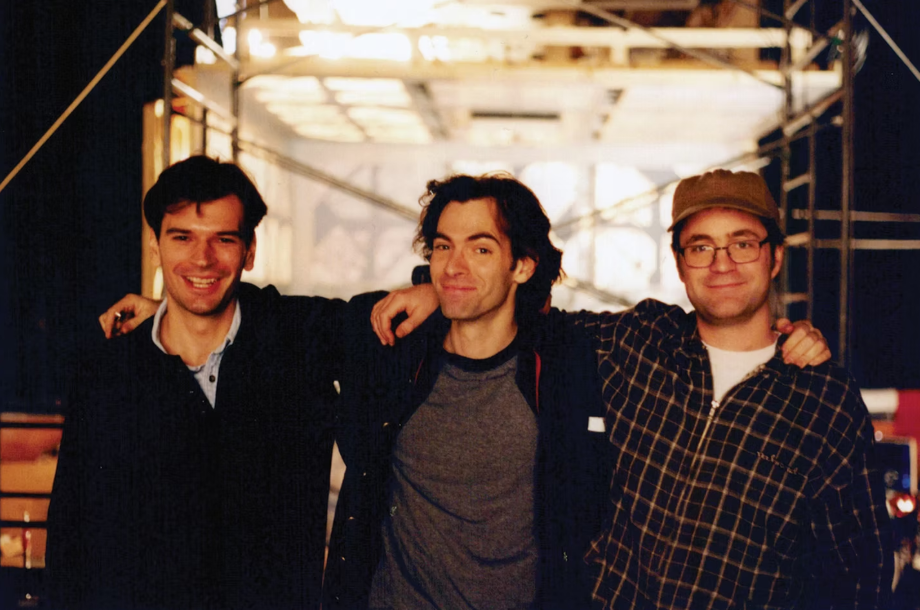
“Andre Bijelic, Cube’s co-writer, who was in the same University class, helped develop the concept,” he continues. “My original draft was a little more Terry Gilliam absurd. Graeme Manson from the Canadian Film Centre came aboard as our other co-writer, and he really dimensionalized the characters. The curse of independent filmmaking is that it’s a sprint. Getting the money for Cube was predicated on a rewrite. It was harrowing; you have to take a step back before you take a step forward. I almost quit. Graeme said, ‘If you quit now, you may never make a movie.’ So, I stuck it through,” Natali explained, citing the origins of Cube and inspirations for such an undertaking.
For a movie made at “a sprint” and on a diminutive budget, Cube is incredibly well-choreographed. There’s not a frame that suggests it’s low-budget or from first-time filmmakers. “I storyboarded since I was a kid, making Super 8 movies. Especially on a low budget, it was important that every shot was planned and illustrated. But then on the first day, I threw all that out. On TV, I do the same things; there’s a psychological aspect to it. It helps to have a plan when you’re walking in. There’s an element of presentation that gets everyone on board.”
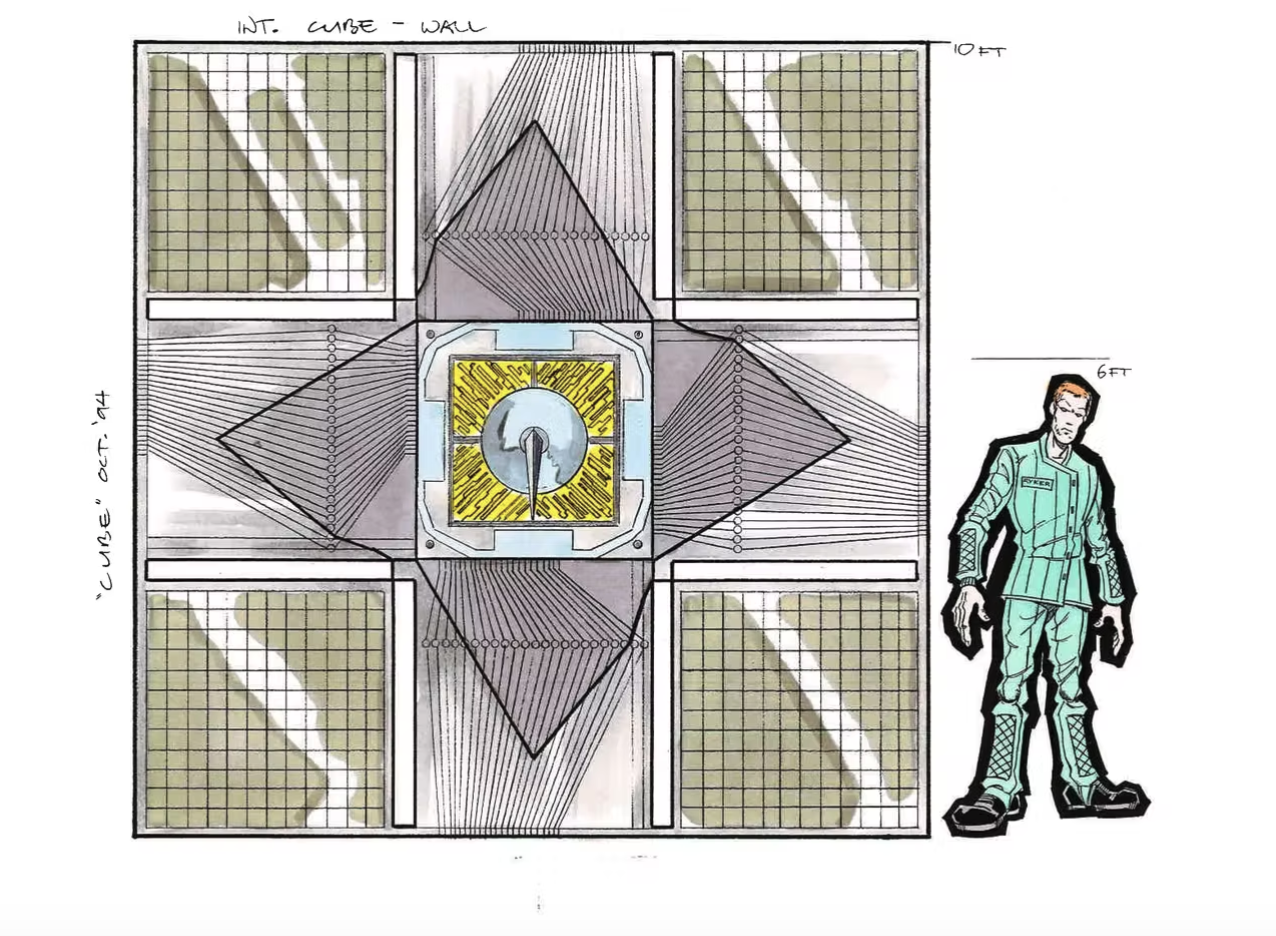

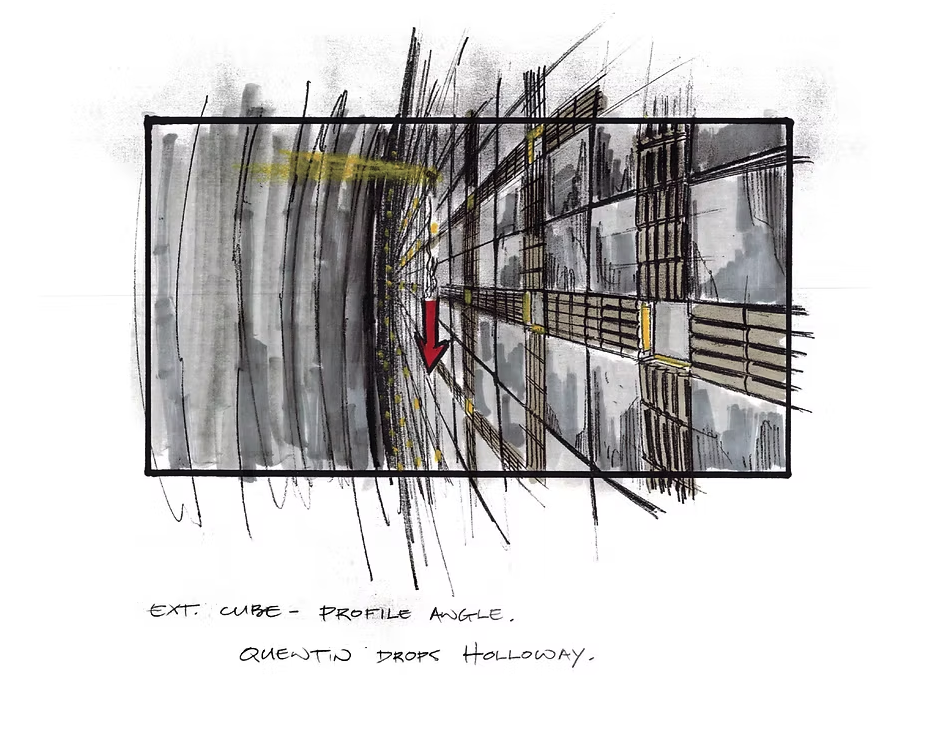
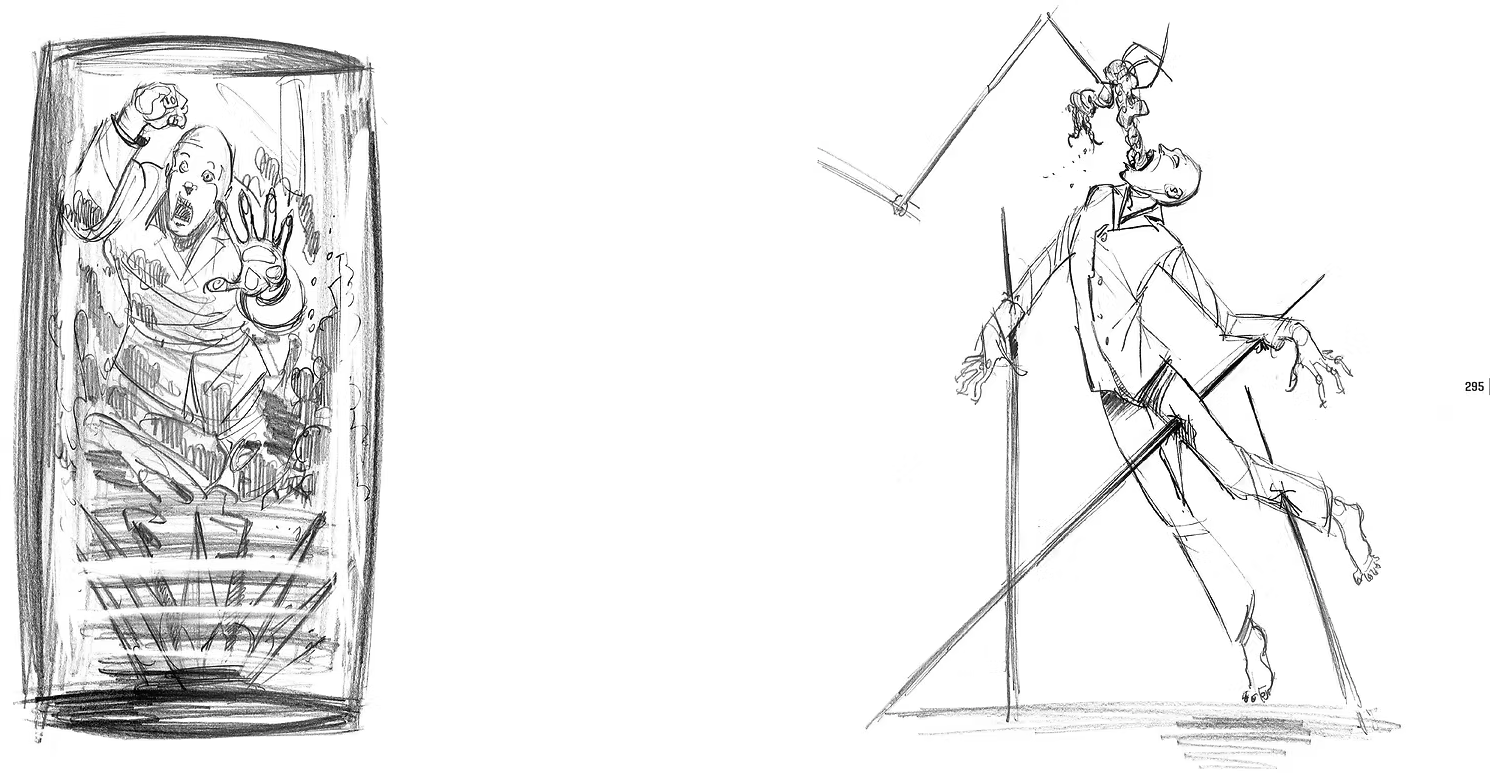
Cube storyboards by Vincenzo Natali. Click here to see more behind-the-scenes materials from Cube on Vincenzo’s website.
When approaching a single location, Natali found inspiration from the master of suspense. “There’s a great Hitchcock movie, Lifeboat, that takes place on a lifeboat. It encouraged me. There aren’t many movies in the genre set in a single location. Even though you don’t have an evolution in scenery, you can have an ever-changing visual. The wardrobe [Wendy May Moore], the makeup [Louise Mackintosh], things are changing regardless of a stagnant setting. We designed the sets so we could change the colour, and you see a new space at the edge of the cube. But the illusion is a sense that the cube could move.”
One realization while watching Cube in 2026 is that there is no indication of the year it takes place. “We were aware of that, and I think there are some things in there that I regret. I was excited to take out any cultural time or place. It wasn’t very politicized, and we cast without any race in mind. We didn’t talk too much about the underlying metaphor. It’s about life, you’re dropped in the world with no map, and you have to find your way through it. You can read it in so many ways with an Orwellian influence. Andre was my first co-writer, contributing to the depth of characters and the Kafka-esque thematic elements. Between Andre, me, and Graeme, we were striving to make something up to interpretation that relied on structure rather than politics. There weren’t any math wizards on our team, but we did reach out to a PhD friend, David Pravaka, to help with prime number mathematics. We had a concept, but not the logistics. We wanted that larger meaning to be ambiguous, but solvable.“
Even with the timeless qualities, Cube did have its fair share of critics upon its release. “One review said, “people wouldn’t act like that.” I don’t know about that today. If you cast the right actor, you’re 90% done with your directing responsibilities. I did write a backstory for each character that I didn’t share with the actors, so they could fill in their own blanks. They were all amazing in their own ways, but it was by no means an easy movie for the performers; they were enthusiastic and supportive, not just for their characters but for one another. Everyone just wanted to make the best movie possible.”

When producing something so idiosyncratic for his first feature, Natali had to trust himself beyond his comfort level. “You need blind faith; if you’re a pilot, you have to trust your instruments, because if you trusted only what you could see, you’d fly into a mountain. It’s something you learn with time. I had a very good support team. The DP, Derek Rogers, was wonderful and mostly operated, which got us to shoot very fast. It never really felt like we were operating on a 20-day schedule. We couldn’t afford overtime, so our 2nd unit day went about 30 hours; the last shot of the film was the first scene in the movie. Production Designer Jasna Stefanovic had to design the set beyond what was on the page. She wanted to add German expressionistic chaos, but also have it act as camouflage for the traps. It’s just very unique and not really coded in any other aesthetic.”
With 30-hour workdays and an exhausting crunch to finish shooting, Natali carries the lessons from Cube into today’s productions. “Filmmaking has gotten much easier than film producing since Cube. The business is at a whole other level of complexity today, which makes it extra hard. There’s a psychological element, there’s a danger. There’s a saying that ‘Hollywood kills with encouragement,’ so you can perpetually get caught in always chasing the character. You might not get a yes, but you won’t get a no, endlessly pitching a project that’s never going to exist. Movies are extremely expensive. You’re serving many masters. There’s a price to be paid. My experience with getting Cube greenlit gave me the vocabulary to identify red flags.”
To handle the stressors of developing a film, Natali has some very salient advice for anyone in the industry: “I think it’s important to do other things to provide gratification. You should be writing all the time, but not just necessarily scripts. I wrote a comic book for myself (TECH), and it was so gratifying. It required no permission. You should be able to do small creative things, not just to keep yourself sharp, but because you enjoy it. I recorded a few albums (Delicate Machine and Origins), but again, the same thing – I started playing ambient stuff, and I found it really stimulating. It’s nice working in a medium where you have no pretense of being good. If I’m directing, I have the pressure to be good. With music I have none, and there’s a certain freedom in that. There is a commonality in timing and shaping. You find you know more than you thought you did.”