Through memories and stories from DGC Ontario Members whose lives were touched by this Canadian cinematic icon, we highlight his enduring legacy, from founding the Canadian Film Centre 30 years ago to mentoring up-and-coming Canadian filmmakers with his unique blend of warmth and passionate insight into the craft. Below, you will hear from ten DGC Ontario Members whose lives, craft and careers were influenced by Norman. Special thank you to Director Gail Harvey for providing us with the many photos of Norman she captured over the years.
Director Gail Harvey:
Norman Jewison is the reason I am a Director. His dream was to build a Canadian AFI, and he certainly accomplished that with The Canadian Film Centre. When I was accepted into the CFC as a Director resident, I had previously made one short film that had been in TIFF. Norman was always so kind, honest, and interesting, and always lent a helping hand and support. For some reason, he believed in me.
My dream was to become a Director. During my time at the Film Centre, I became one, and it was incredible, thanks to Norman. I still pinch myself when I think about the fact that he was my mentor.
At the Film Centre, Norman would spend time helping us block scenes, talking about the realities of filmmaking and giving us moral support. He also became a friend. Because of Norman, I was supported by Arthur Penn, Dan Petrie Sr., Wim Wenders, Clint Eastwood and many, many other incredible artists. All of these filmmakers were his friends! Robert Ebert came to the Film Center and went frame by frame through Citizen Kane. Scorcese’s Editor, Thelma Schoolmaker, also came and went frame by frame through Raging Bull.
I shot my first feature, The Shower, at the Film Centre in one of the cottages. While shooting and editing the film, I often thought of things Norman had said. The film went on to be nominated for three Genie Awards (now known as the Canadian Screen Awards).
The last time I saw Norman was March 21st, 2019. I was directing a movie in Vancouver when he called and asked me to come to a Film Centre event in Los Angeles. So, I flew down and was able to shoot the last photos I ever took of him.
I will never forget his smile.

Director Gail Harvey’s final portrait of Director Norman Jewison, March 2019
Supervising Sound Editor Michael O’Farrell:
I worked as a Supervising Sound Editor on many of Norman Jewison’’s films. He basically gave me my first big break working on large-scale features, which led to a long career in Sound both in Canada and the US. On Agnes of God, I got this idea that we would do all the foley on location in a monastery. Sound Editor Andy Malcolm, my frequent collaborator, got dressed up in a nun’s outfit. I had a monitor on a rig in front of him, and we were micing from room to room. Norman was really receptive to the whole thing, and I got to know him over the course of filming. After we wrapped, he planted a story with Sid Edelman in the Toronto Star about the Sound on Agnes of God, which was great.

Agnes of God (1985)
A couple of years later, they phoned me to do Moonstruck along with my partner at the time, Sharon Lackie. When we first cut it, Norman had scored the whole film with opera music. All the opening credits were opera. We all loved it because it’s a fantastic movie and we’ve seen it 50 times. We screened the film for a preview audience, and there’s the opera music right at the front. Nobody was laughing for about the first hour, and Norman was going crazy. I just heard him behind me walking up and down the hallway, jiggling the change in his pockets. But when Picture Editor Lou Lombardo added “That’s Amore” to the opening, all of a sudden, people got it right off the top, and they were laughing already during the credits.
As I got to know Norman more and more, we became friends and I got to meet his family up at the farm. He was really a genuine, lovely person. We had a number of somewhat tense conversations over the years about the projects we were working on, but they were all in the interest of doing the work properly and getting the best possible final product, and he was very open to ideas and what everyone brought to the table. His insistence on being in Canada and using Canadian talent created a lot of opportunities for Assistant Editors, some of whom went on to become great Editors. You always felt like you were in that film family with Norman.

Norman Jewison in Toronto. Photo credit: Gail Harvey
1st Assistant Director Andrew Shea:
On working with Norman Jewison as the second AD on Moonstruck: Cher was often distracted by Norman, who was like an audience member. He sat right behind the camera (sometimes right on the dolly), laughed throughout takes, and enjoyed the performances. She couldn’t believe it. She was like, “Norman, you’re laughing out loud.” He couldn’t help himself. He just loved everything about it.

Norman Jewison and Cher on the set of Moonstruck (1987)
Picture Editor Ron Sanders:
I was lucky enough to cut a film with Norman Jewison – Dinner With Friends. It was an honour and enormous fun. One of my greatest career disappointments was missing Moonstruck. The discussion proceeded, and I was offered the film, but it was pushed several times, and I had to withdraw because of other commitments. I am still sad about that.

Dinner With Friends (2001)
Post Production Supervisor & DGC Ontario Post Production Caucus Rep James Porteous
When I was about 14 years old, I was struggling with finding my way in life. My parents had recently separated, and school was not necessarily going according to plan. One day, when I was practicing truancy, my father found me in the local pool hall and was understandably unamused. So, he took me down to his workplace, gave me a lab coat and a broom, and said, “If you’re not going to school, you’re going to sweep floors.” Things felt pretty grim.
My father used to work in the Traffic Department for Screen Gems in the mid-sixties when they shared a building with Columbia Picture on Carlton Street in Toronto. Columbia Pictures was on the main floor, and Screen Gems occupied the second floor. I worked primarily on the second floor and occasionally in the basement, where there were film vaults and a mid-sized 35mm screening room. I managed to parlay this into a part-time job a few days a week after classes.
It’s here that I learned some editing techniques, hot splicing film, and how to work with flatbeds and projectors. I was often left on my own to do film filing, garbage cleanup and other management duties, but my real passion was learning how to run the 35 mm Carbon Arc Projectors in the screening room on the lower level. Alf, the projectionist, who was ancient at the time when I met him, taught me everything he knew about their operation and maintenance. By the summer that I turned 16, I pretty well had the run of the shop. Everyone knew me, had confidence in my abilities and they were all pleasant to work with.
On the first Thursday of every month, screenings would be held for “The Brass” in the theatre. Many of these films were “R” rated, so as a 16-year-old kid, I wasn’t actually allowed to see them. But once they were all seated, I used to sneak into the projection booth and help Alf with the reel changes and re-winds. Then, one night, he said, “You run this one tonight. Wake me up if you need any help….” That evening changed my life forever.
From the opening reel, I fell into the movie. I was stunned at the way it was shot, the script, the acting, the music and most of all, the social message it was portraying. This was near the end of the sixties, and there was a lot of racial turmoil in the world. I became so engrossed that I almost missed a couple of reel changes. I had been given that epiphany moment where I knew that the film, television and music industries were going to be my destiny and path forward in life.
After the screening, as the Execs were piling out of the theatre, I was loading the reels back into their cans when the Director of the film noticed me, walked over to me, shook my hand, and said, “Thank you, good work.” That Director was Norman Jewison, and I had just screened In the Heat Of The Night before the public had a chance to see it. I managed a very shy “Thank you,” but I had been changed forever.
As the years went on, I had many successes and failures, but I was very lucky. I did manage to carve out a successful career in the industry. Several years later, I had the opportunity to work with Rod Steiger on Sword of Gideon and again with Norman Jewison on the Painted Word series. I know that there are members of our craft who had many more experiences working with Norman than I did, but one single event that happened to me as a misguided kid in the sixties changed my life irrevocably, and for that, I am eternally indebted.
Norman Jewison could be playful, impish, demanding and infinitely creative. But above all, he inspired us all to do our best work and to reach for the stars.
Thank you, Norman, I am forever humbly grateful.
Director Holly Dale:
Norman Jewison has had a huge impact and influence on my career. I was fortunate to be a Director Observer on Norman’s film Agnes of God. I was also selected to attend the first year of programming at the Canadian Film Centre.
Norman shepherded me as I developed as a Director. Norman not only had a great influence on who I became as a filmmaker but also a great influence on countless other filmmakers in Canada. As successful as he became, he never forgot his roots. He brought so much to the Canadian film industry comparable to none. I believe the level of excellence in the Canadian film industry today is because of what Norman Jewison contributed to it. I’m eternally grateful to Norman for his generosity, the Canadian Film Centre and his personal guidance. He’s a national treasure. I miss him and am blessed to have been his friend.
Director and DGC Ontario Chair Annie Bradley:
I applied to the CFC Directors Program because of the influence that Norman Jewison had on me as an audience member. It was the profound nature of his work, which was both deeply political and personal. His work felt like a statement of how he felt about the world and its challenges. But his films were also powerfully entertaining, often shaped by his unique dark humour.
He fought against injustice of any kind, championing the underdog. We shared a belief that movies are like music, each with its own unique rhythm and cadence. When my CFC short film Pudge was finished and selected for TIFF, he gave me such kind words of encouragement. I will never forget his feisty spirit or his kindness.

Norman Jewison in his Toronto office. Photo credit: Gail Harvey
Production Designer John Dondertman:
My first DGC job was working as a Trainee on Agnes of God. DGC Ontario Member Carol Spier was the Art Director of that film. Norman Jewison was Directing, Sven Nykvist was the Cinematographer, and Ken Adam was the Production Designer. So I was working with these rarefied, talented artists considered some of the best in the world. I was always a film buff, but at the time I didn’t really realize the opportunity I had stumbled into. I often joke that I’ve since worked my way to the bottom because I got to work on this Academy Award-nominated movie so early in my career. I was brand new to the film industry, but I was able to sit in a basement with Norman Jewison and these incredible artists and watch dailies. I later worked with him again on a series of short films called Picture Windows based on iconic paintings. I consider myself lucky that I was able to start my career working with Norman. He was an amazing and compelling storyteller and had the sonorous voice to match.

Cinematographer Sven Nykvist and Director Norman Jewison on the set of Agnes of God (1985)
Director Sid Zanforlin:
I was directed by him when I was a Director in Residence at the CFC in 2002. He explained that his method was to get the actors excited to do the part, and he would whisper action verbs in their ears as they rehearsed. He had a few of us get up and do a scene. I played the Dennis Quaid part in his just-finished HBO film Dinner With Friends, and as I was rehearsing, he came up to me and whispered, “Entice, celebrate the lines.” Norman explained that day with a grin that it was all about the “razzle dazzle.” I use this method of planting seeds and positive play to this day when directing. He has been instrumental in my own awe of the craft.
1st Assistant Director David Antoniuk:
I met Norman during the production of Dance Me Outside, where he was a producer. I worked in his office in Canada during the Post Production of his movie Only You and then on set for Bogus. Norman even wrote one of my recommendation letters to get me into the DGC.
While we were in Post Production for Only You, we had a small screening for a group of insiders. It was the first time that anyone outside of editorial had seen the full movie. Shortly after the screening, he ducked out to the bathroom, and I ran into him in the men’s room. I told him, “The movie’s good, Norman. People will like it.” He grabbed my hand, squeezed it tightly and let out a sigh of relief, letting go of the tension he was clearly holding. Even at his level of experience and accomplishment, he still went through the same human journey that all filmmakers go through. “Will they like it? Will it be good? Does it work?” He was a true artist.

Director Norman Jewison on the set of Only You (1994)

Norman at the Canadian Film Centre in the early 1990s. Photo credit: Gail Harvey
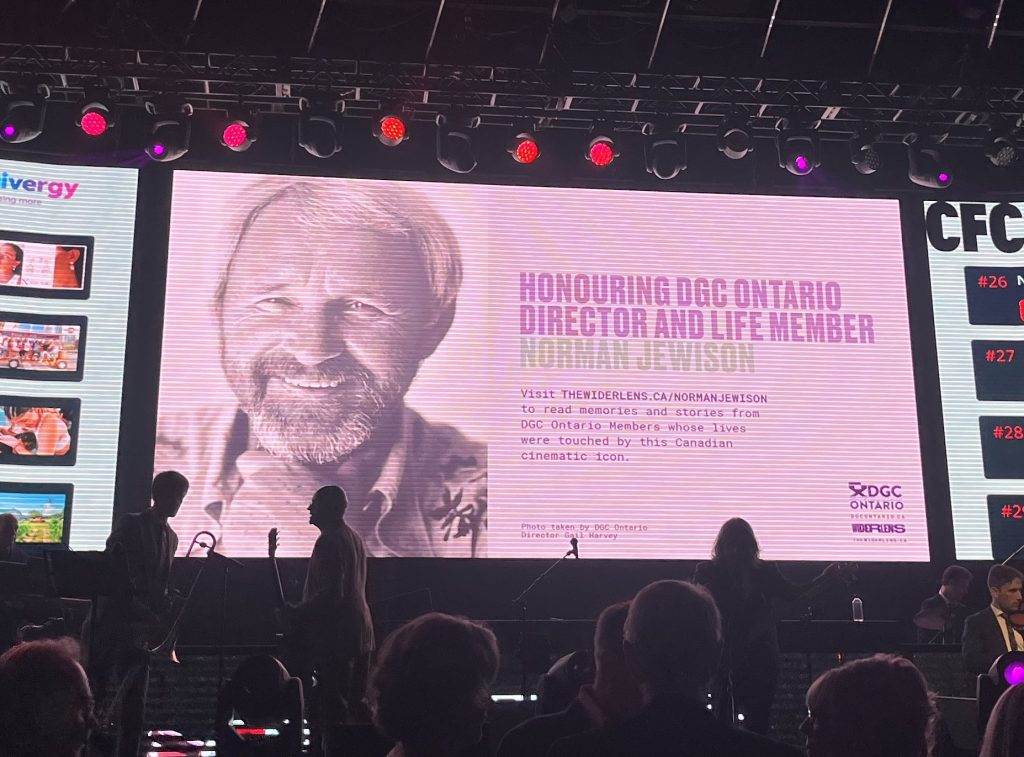
DGC Ontario’s tribute to Norman Jewison at the 2024 CFC Gala, May 16 2024