From Gilead’s haunting visual style to its emotionally resonant soundscapes, their contributions defined the show’s iconic aesthetic and transformed a classic Canadian novel into a landmark of television production.
Picture Editors Chris Donaldson, Wendy Hallam-Martin, and Ana Yavari, Sound Designer Brennan Mercer, Production Designer Elisabeth Williams, Art Director Martha Sparrow, “Devotion” episode Director David Lester, and Location Managers Anne Richardson and Jeremy Pinard reflect on the series’ evolution, how it shaped their craft, challenged them creatively, and left a lasting impact on their careers – and the entire screen industry.
We sat down with these standout creatives for a candid conversation about their time on The Handmaid’s Tale, the nuances of developing its intricate world, and the collaborative spirit that brought the series to life.

Can you tell us about the show’s language and tone and how it evolved over the last six seasons, especially as it transitions outward from Gilead into Canada and beyond?
Picture Editor Chris Donaldson: The first season, especially the first five episodes, was told almost entirely from June/Offred’s point of view. So everything we did – our cuts, our shot selection – was all to heighten her character’s subjectivity. She knew so little of the world outside of her bonnet, especially for those first five episodes, and Offred’s subjectivity was what we were trying to capture the most. You only saw things through her POV. You only had the information she had.
In episode six of the first season was the very first time we switched POV to Serena Joy. We used a lot of the same stylistic techniques, except now we were using them on a different character. As the seasons progressed, there was more A, B, C storytelling, and the grip on subjectivity lessened. It took on a different texture once June left Gilead halfway through the season. There were still those things when we returned to Gilead, but it wasn’t quite as subjective or as heightened as when June was there.
Picture Editor Ana Yavari: I always go back and rewatch the first season because there was a kind of language that I thought was so special. Even while the story was changing, I like to always go back and try to accent with some of that early stylistic language, especially for some of those characters who still partly exist within that mindspace, like Serena and Rita. The first two seasons were mostly in Gilead, so we’re living that kind of slow, peaceful, organic kind of life. And then in the last few seasons, more and more characters have made it out into Toronto. It’s a bit faster-paced, with less of that quiet intensity we had in the beginning.
Production Designer Elisabeth Williams: I initially didn’t work on the first season of the show. I graduated from Art Director to Production Designer on Fargo, and the Executive Producer, Warren Littlefield, was also EP’ing The Handmaid’s Tale. At the end of my second year on Fargo, he offered me the position of Production Designer on Handmaid’s because the team was changing. They had just finished their first season, and the show was a massive success. That was a huge turning point in my career.
A lot of things changed over the seasons – the way things were shot, the lenses, the lighting. But what was in Gilead was somewhat respected throughout. I was very respectful and kind of in awe of what had been done before. I didn’t feel like I needed to put my stamp on things just for the sake of it. But as the show expanded, I could bring in my own finesse to new spaces or even to evolve existing ones, like adding rooms to the Waterford House, designing the greenhouse, creating new environments like No Man’s Land or the refugee safe houses. It was always about telling the right story through design, rather than changing for change’s sake. And I think that helped it stay consistent yet grow naturally over time.
“What Handmaid’s Tale did was prove beyond a doubt that Canadian crews and Post professionals are among the best in the world. The show was a critical and artistic success, and it was largely built and delivered by Canadian artisans.“
-Picture Editor Chris Donaldson
Sound Designer Brennan Mercer: We created all these kinds of signature sounds in the first season, and Adam Taylor created an amazing score. It’s not like we tried to get more epic throughout the seasons with sound; it stayed grounded in the same pocket of season one. Over the course of six seasons, we began to see people who escaped and came to Canada, or we went to New Bethlehem, and each of those locations had its own sonic palette. New Bethlehem had coastal birds and waves, while the Canadian safe houses had subtle, offscreen audio cues to show that this was a place of resistance. But the emotional consistency from season one helped guide that.
Director David Lester: Having been involved with the show since the beginning as an Assistant Director, the actual experience of stepping into the role of Director in season 6 was beyond exhilarating. I had the privilege of directing a variety of 2nd unit scenes in seasons 2 and 5, so I did have a strong belief and trust that I would know what it would take to bring an episode to life. I also fully understood the responsibility of ensuring we maintained the integrity of a show that was established by masters of the industry. It’s a huge challenge to walk into a show’s sixth season and make sure you’re creating an episode that honours its roots, while trying to infuse your own voice.
The fact that this show is told from June’s POV creates a solid foundation for the visual storytelling, and you can always return to that as an anchor if you ever get lost in how to approach a scene. It’s what made the leap to Director rather painless, because I was so familiar with the characters and the world of Gilead.
“The popularity of the show was an incredible thing to witness, and it became a direct reflection of the quality of work put in by the hundreds of technicians over the seasons in and around Toronto.“
-Director David Lester
Art Director Martha Sparrow: I came on as supervising Art Director for Production Designer Elisabeth Williams in Season 2, and returned for 3 and 4. I am now Production Designer on the follow up series The Testaments, which we are very excited to be shooting currently.
In Season One, Julie Berghoff, the Production Designer for the first five episodes, established a strong vision for Gilead, focused around the Waterfords’ home and Offred’s confined world within it. As the series progressed over subsequent seasons, we expanded beyond that first-person perspective to depict a broader, more established vision of Gilead. Colonial architecture became the design language of this world of male power. Governmental institutional architecture made use of some of the excellent examples of Brutalism here in Ontario. Environmentalism also became a key influence—reflecting the narrative’s link between industrialization and the fertility crisis—which guided our use of materials and design choices. While contemporary technology still had a place, particularly in medical settings, Gilead overall was shaped by a deliberate return to traditional architecture and organic practices.
Location Manager Jeremy Pinard: They really liked the Brutalist look, so we were at universities, U of T in Scarborough, U of T in Mississauga, some of these really great buildings that gave us that look that they loved for Gilead. The old Waterford house on Aberdeen in Hamilton was difficult because it was in a wealthy area that had already seen a lot of filming. We had to manage expectations from the neighbourhood and keep the peace. That’s a big part of helping establish and maintain the look of the show, too: not just picking the locations, but being able to keep using them
.Location Manager Anne Richardson: We always get great direction from our Production Designer, Elisabeth Williams, who we love. Through her direction, we just started spitballing places and ideas together with our Scouts. When we’re not in Gilead, we’re often in Toronto. So in that respect, it’s great because we can shoot Toronto for Toronto, looking for the dystopian world. We do have to go outside the area quite often, places like Cambridge and Brantford, to find some specific looks. But often it’s really figuring out what the script calls for. We go out and get a couple of options to bring to the table, and hopefully one of them lands.

The Waterford House location in Hamilton, Ontario.
Tell us about your collaborative process with your teams throughout the series.
Chris Donaldson: In the early days, Bruce Miller was the writer laying out the emotional groundwork, and Reed Morano was entirely focused on the aesthetic and formal aspects of the show. Wendy and I, after Julian Clarke left, took what we developed with Reed and applied it across the board as new Directors came in. The show was so formally specific, and unlike many series where Directors might shoot in a more conventional way, the structure of Handmaid’s demanded consistency. So Wendy and I worked closely with each director, helping them understand the established tone and making sure everything still fit within the visual and emotional language that Reed had created. That level of collaboration was essential. It wasn’t just about editing, it was about preserving the integrity of the show’s DNA.
Ana Yavari: The editorial team was so collaborative. Even when I was still an Assistant, Chris and Wendy would always include me. I was assembling scenes for them, doing temp work, and sometimes putting together promos we’d send to producers. There was a culture of sharing work with each other early, even before the Directors got involved. We’d bounce around cuts and ask for feedback. Everyone wanted each other’s perspective and trusted one another. Nobody was too precious about their work, and that made it comfortable to take creative risks. It was such an open and supportive environment.
Elisabeth Williams: When I came onto the show in season 2, it was already in motion, but the Producers, especially Warren Littlefield, trusted me to pick up and carry forward the vision. I inherited an incredible Art Department, and we grew into a real family. Many of the people I brought in or promoted in season two were still with me at the end of season six. It really proves that with the right team, you can do anything. The great thing about The Handmaid’s Tale is that there’s this beautiful human quality to it, and I don’t know if it’s the harshness of the subject matter, but everyone working on the show wanted to be friendly and get along with each other. We had amazing Producers who helped when it was needed, but also let us do our jobs. It gave everyone a sense of ownership of their own position on the show. It was an amazing experience.
“This show made me believe in myself as a designer, a leader, and a storyteller. It changed my life.”
-Production Designer Elisabeth Williams
Brennan Mercer: Working with our Executive Producer Sheila Hockin, our Supervising Sound Editor Jane Tattersall, and the Picture Editors was key. We’d keep evolving the sound right up to the final mix. We were always trying to make the soundscapes not just technically solid but also make sense emotionally. The whole process made me more confident about pitching creative ideas.
David Lester: Having AD’d for many years, and on this show from the very start, made a huge impact on my approach to directing. Starting with prep, having a strong understanding of scheduling and helping to build (and stick to) a timeline really helped to inform the shot listing sessions with my DP, Nicola Daley. We let ourselves run wild with ideas in the early days of prep, while being very conscious of the restrictions we knew we’d eventually face. I’d spent three seasons establishing the background on the show as the 3rd AD – how they act in Gilead, how they act outside of Gilead, and how they interact with one another.
As 3rd AD for the first three seasons, I’d often listen to Max Richter while watching us shoot and kept a running list of music cues I dreamed of using on the show if I ever had the opportunity. Alongside Adam Taylor’s haunting score, these tracks influenced my sense of camera movement, background action, and scene rhythm.
Our 1st AD, Michael Johnson, and 2nd AD, Dominika Jurek, were incredibly collaborative. Knowing their needs helped us stay aligned. Back in season 3, I had a conversation with DP/Director Colin Watkinson about performance tone and background movement. I promised myself I would do the same if I ever had the opportunity, and alongside our 3rd ADs, Denzel Watson and Anthony Rosset, and our set PAs, Christie Pawluch and Natalie McFadyen, I was able to fulfill that.
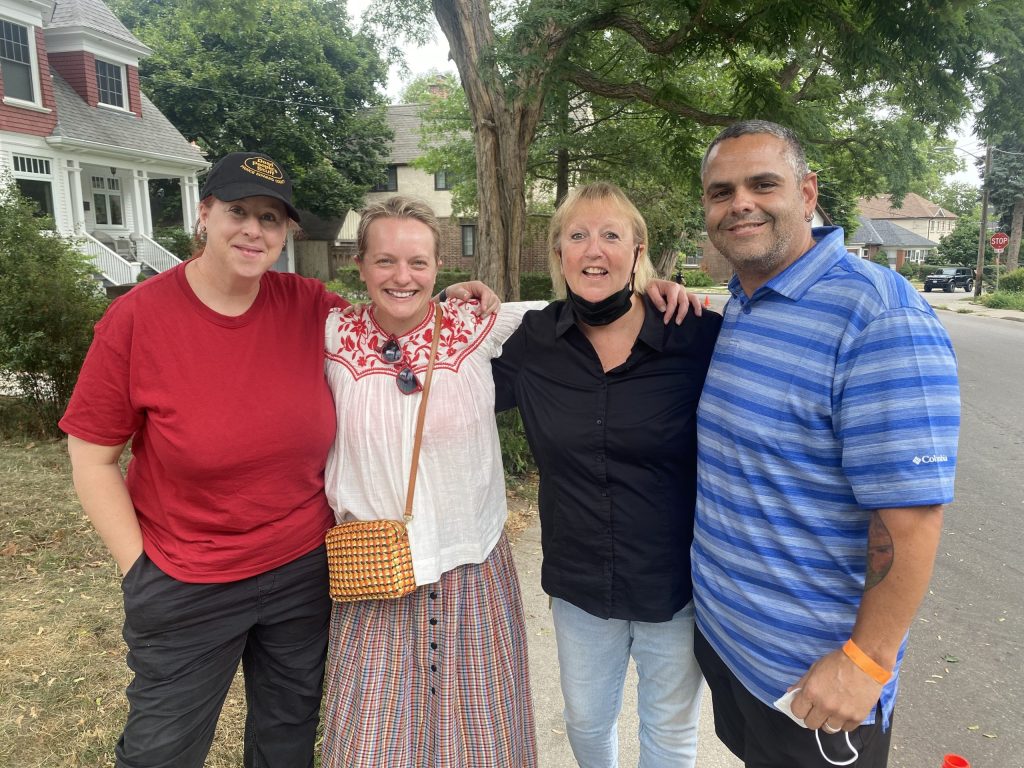
Anne Richardson: Jeremy and I had a good system – we shared an office, and divided responsibilities. I handled script breakdowns, oversaw the scouts and general planning, while Jeremy managed logistics like permitting, unit coordination, parking, and working with transport and ADs. Because we were one unified team across all the episodes, other departments didn’t have to track down different Location Managers. We always had the full picture. That consistency really helped with production, with maintaining relationships with homeowners, and all our contacts at our recurring locations.
Jeremy Pinard: Before we adopted the single-team model, a lot of shows had different Locations teams for different episodes. That created confusion, especially with ADs or when dealing with recurring sets. We shifted to a more streamlined model, and it made everyone’s life easier. Directors, Designers, and homeowners all knew who to talk to. There was never a question of, ‘who’s covering this?’
Looking back, is there a particular scene or episode that stands out to you, either because it was especially challenging or especially rewarding to work on?
Wendy Hallam-Martin: There are a few, but the one that stands out is episode three of the first season. That was the episode where Alexis Bledel’s character Emily wakes up in the hospital and finds out that she’s been surgically mutilated, and her lover was dragged away and hanged in front of her. It was just so delicately crafted and emotional. There’s a sequence that’s all done in one shot, and the feeling of that entire episode just stayed with me. Also, I’m proud of the opening of season two, the hanging scene. It was incredibly intense and difficult to cut, but that episode actually won me the Emmy.

Chris Donaldson: One of the episodes I’m most proud of is season two, episode 10, where June reunites with her daughter, Hannah, at this abandoned country house. Jeremy Podeswa directed it, and it was one of those episodes where the emotional power of what everybody had done – the writing from Yahlin Chang, Jeremy’s direction, the actors, everyone on set – just coalesced into something extraordinary. I felt like the steward who had to carry it across the finish line. I remember working on a very technical scene without sound, then turning the sound and music back on, and I just burst into tears. The weight of it all hit me. To feel like I honoured everyone’s contribution was something I’m genuinely proud of.

Ana Yavari: The first episode I ever cut was really nerve-wracking. It was with Kari Skogland as the Director, and she used to be an Editor herself, so it felt like there was no hiding! But between Chris and Wendy giving me early notes and working closely with Kari, I found it incredibly rewarding. The most challenging episode for me, though, was when June escapes Gilead and arrives in Toronto. I originally cut it in a way that made her arrival more tense, awkward, even a little haunted. The producer, Yahlin Chang, also wrote it, and wanted it to feel more like a joyful moment, so we had to find that bittersweet middle ground. It took a long time to find the right balance of music, the right length of shots, and where we stayed on June’s face. That was probably the most technically and emotionally intricate edit I’ve done.

Elisabeth Williams: It’s so hard to pick one favourite set or scene. Every set had that magical moment where all the planning and design finally came together. Whether it was something impressive like the Washington Monument or something as seemingly mundane as a public bathroom where June was bleeding and scared, those moments where the space became real always gave me chills. One scene I do remember well was in season five when June was being held at a Canadian police station. The room was small, bureaucratic, pretty sterile. But we worked so hard to make it cinematic. That was harder than building a mansion. Making something ordinary resonate on screen, that’s the real challenge in design.

Anne Richardson: Every season, we had to find places to hang bodies – on walls, in trees, or from gallows. That could be really tough, both logistically and emotionally. We’ve had to pull back or shift locations when residents didn’t want that imagery in their community. One time, the props department dressed the bodies the night before on Market Street in a high-density condo area. We came back the next morning to a lot of complaints. So we made a rule – nothing graphic goes up until the day of filming.
Jeremy Pinard: People thought the bodies were real, and we were getting phone calls before we even showed up.
Everyone wanted each other’s perspective and trusted one another. Nobody was too precious about their work, and that made it comfortable to take creative risks. It was such an open and supportive environment.”
-Picture Editor Ana Yavari
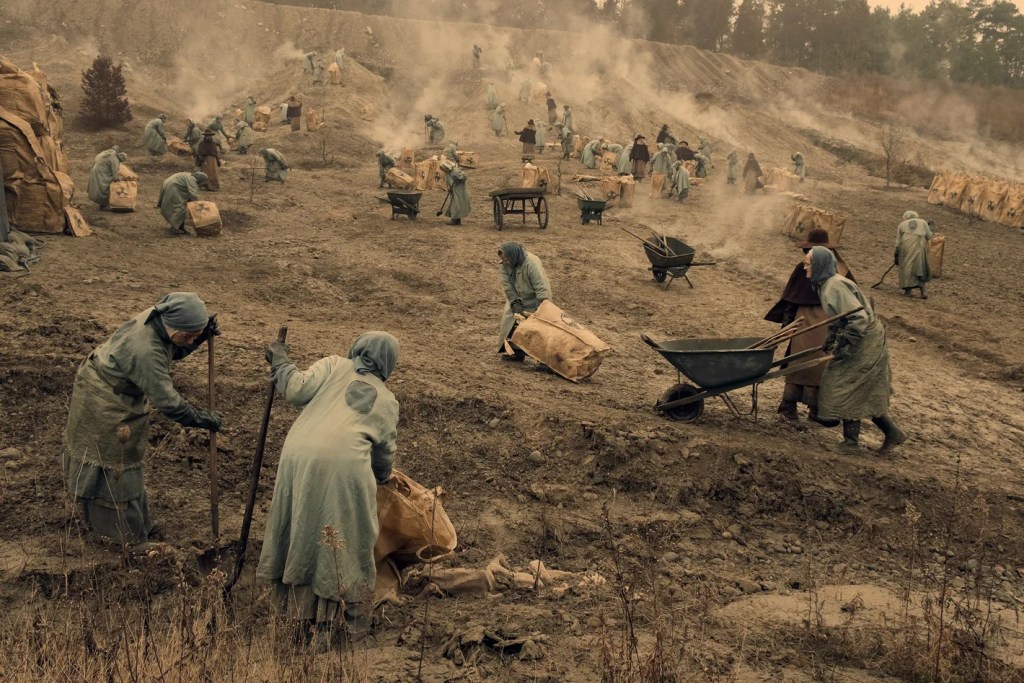
Martha Sparrow: The Colonies in Season Two were one of the most memorable sets we created. It required a vast, desolate landscape that could convincingly portray scorched earth, where women were condemned to manual labour of moving contaminated soil. The only suitable location we found was a hillside of eroded soil in an abandoned gravel pit. Access was a major challenge—we had to construct a road just to transport build materials and shooting equipment.
The build was plagued by wet November weather and continuous freeze-thaw cycles, which rendered the road impassable for much of the prep period. The crew had to carry materials in by hand and hike in and out daily. Set dec brought in huge quantities of landscaping sacks to be filled and stacked. Construction built huge structures on site to resemble tarped earth piles. Special FX embedded pipes into the hillside, using our set build to conceal heating tanks that produced a dramatic steaming earth effect. On the morning of the shoot, we arrived in a heavy fog and freezing temperatures. The resulting scene—a crowd of labouring women at sunrise on a steaming hill—was haunting and unforgettable.
Brennan Mercer: One scene I really loved working on was in the most recent season, where June is on a train to Alaska. She’s had to leave her daughter, and you see her shifting through these different emotional states. There’s a dream sequence that begins with the rhythmic clacking of the train tracks, which slowly becomes more abstract. That clack becomes this pulse that blends into the music. Then we enter this dreamlike field where June sees her daughter, and we used cicada sounds that trail into light flares. Eventually, those cicadas morph into this high-pitched metal squeal that turns out to be the real train brakes snapping her out of the dream and into anxiety. It was a great blend of grounded realism and stylized design.

Do you feel that working on the show shaped you as a creative?
Elisabeth Williams: I was petrified when I started. I was taking over from someone else, the train was already moving, and I didn’t feel ready, but Warren [Littlefield] believed in me. It was very humbling, because the first thing I did when I got there was to tell my team, who had been there already doing their jobs, “I just got here and I don’t know what I’m doing yet. So I’m going to be relying on you guys.” I don’t come from a cinema background originally; I went back to school to study it, but I’ve always had this sense of knowing instinctively what a space should feel like. Since then, I’ve learned so much. This show made me believe in myself as a designer, a leader, and a storyteller. It changed my life.
David Lester: The Handmaid’s Tale has been a massive part of my life for nearly nine years. I was sitting in a coffee shop in Fredericton two years ago when I wrote an email to the producers, expressing every bit of passion that I had for this show and why I would love nothing more than to direct an episode. I slammed the laptop shut after pressing send and immediately left the coffee shop, knowing that I was asking for something really big here. I was asking the producers to take a chance on me. I knew it would challenge every ounce of my creative fibre and teach me lessons I didn’t yet know I needed to learn. The fact that I made this leap on a series that became part of the zeitgeist is incredibly special, and I’m forever proud to have been a part of this storied show.
Ana Yavari: This show gave me my big break. I was an Assistant Editor working under Chris and Wendy, and they trusted me to start cutting scenes and contributing more. That kind of mentorship is rare. Because The Handmaid’s Tale was so well respected, it gave me credibility. It helped me land other big jobs. But beyond the career stuff, it made me more confident. It showed me that I could rise to the challenge, and that people I admired believed in me. I owe a lot to this show.
Chris Donaldson: I really feel like I learned more from Bruce Miller about story than from anybody else. There were moments when I thought we needed to spell something out for the audience, and Bruce would push back. What he wanted was for the audience to forget, and then remember. The surprise would hit harder. I just thought that was brilliant. Lizzie Moss was also someone who changed the way I work. I really admire her dedication, her artistry – she demanded so much of herself that you felt compelled to rise to that level too. And she trusted her collaborators, which gave us the confidence to try things. Bruce once said to me, ‘Push it as far as you can, we’ll pull you back.’ That permission to explore made all the difference.
“The Handmaid’s Tale was the first project where I truly felt the broader impact my work as a storyteller could have. Seeing the audience respond so strongly made me realize that when I work and pour my efforts into the right projects, the work can speak to people in an impactful way.”
-Art Director Martha Sparrow
Wendy Hallam-Martin: It really taught me a ton. I learned how to tell a story better and how to make visual choices that support emotion and character. I became more confident in my instincts and stopped second-guessing myself so much. I also became a better listener. Now, when I get notes, I try to figure out what’s behind them, instead of just reacting. There’s always a ‘note behind the note.’ That’s something I really learned on this show. It made me a stronger editor and collaborator. And honestly, I’m still learning every day, but this show raised the bar.
Brennan Mercer: As a Sound Editor, I think The Handmaid’s Tale changed the way I approach everything. It showed me how to blend realism with stylized sound design. It wasn’t about flashy effects; it was about getting inside the characters’ heads. That balance, starting from reality and finding the emotional sound cues within it, has stuck with me on every project since. It also gave me more confidence to share my ideas. Even if not everything made the final mix, the support was there, and that’s made me more creative and more collaborative.
Martha Sparrow: The Handmaid’s Tale was the first project where I truly felt the broader impact my work as a storyteller could have. Seeing the audience respond so strongly made me realize that when I work and pour my efforts into the right projects, the work can speak to people in an impactful way. I’ve always pushed for the highest-quality work, but this show gave me permission—and the necessity—to demand it from myself and everyone around me. It required excellence from the entire team. Through the creative process of working with an exceptional Production Designer, and a slew of incredible directors and cinematographers, I’ve grown tremendously not just as a designer, but as a leader.
I now have a team, many of whom have been with the show since day one. Some started as apprentices, others were already among the most experienced in Toronto, but many of the senior team members began in junior roles and grew into leadership positions. Together, we’ve developed into a truly exceptional group. My career has also greatly benefited from the show’s success and the visibility of the awards. That recognition enabled me to qualify for work in the U.S., and several of the show’s executive producers have brought me onto other productions there. Collaborating with crews in different cities expanded my leadership skills and gave me a deeper appreciation for the talent we have in Toronto.
Anne Richardson: It was a very demanding show logistically, and I think it made us more adaptive. We were rarely on stage – we were always moving around, scouting new locations, managing complicated setups. That kind of challenge forces you to think quickly and communicate clearly.
“I’m proud of the opening of season two, the hanging scene. It was incredibly intense and difficult to cut, but that episode actually won me the Emmy.”
-Picture Editor Wendy Hallam-Martin
What impact do you think The Handmaid’s Tale has had on the Canadian screen industry?
Chris Donaldson: What The Handmaid’s Tale did was prove beyond a doubt that Canadian crews and Post professionals are among the best in the world. The show was a critical and artistic success, and it was largely built and delivered by Canadian artisans. For a long time, there was this perception that you had to go to L.A. or New York for a certain level of polish. But this show proved that wasn’t true. It showed the global industry that Toronto, and Canada more broadly, can support world-class, Emmy-winning work on an ongoing basis. That’s a legacy we should be incredibly proud of.
Wendy Hallam-Martin: Some of us have been pioneers, showing that we can do it, that we can take on a show of this scale and artistry and not just manage it, but make it something special. I think the industry here in Ontario has gained more confidence because of this series. I know I have. People worldwide look at this show and see what Canadian crews are capable of.
Ana Yavari: It just showed people that our crews here are just as good as the Hollywood crews. We used to get overlooked for the big jobs, but not anymore. I think Handmaid’s helped shift that mindset. Now, more people trust us and bring their shows here. The relationships are stronger. It feels like we’re finally being treated as equals.
Brennan Mercer: It’s become a calling card for the Canadian screen industry. People reference The Handmaid’s Tale as proof of what’s possible when you trust your creative teams and support them with the right resources. We weren’t just executing someone else’s vision – we were part of crafting it. And that model has inspired other shows to think about how to best use Canadian talent, not just to save money, but to make great television.
“It’s become a calling card for the Canadian screen industry. People reference The Handmaid’s Tale as proof of what’s possible when you trust your creative teams and support them with the right resources.”
-Sound Designer Brennan Mercer
David Lester: The legacy of The Handmaid’s Tale does transcend film and TV. From a production perspective, our Locations team has helped put an incredibly strong footprint on so many locations, spanning Hamilton, Cambridge, Brantford, and seemingly everywhere in Toronto. I know there is a lot of pride in how those towns helped create the visual language of Gilead. The quality of filmmaking has elevated every technician who has worked on any season of Handmaid’s. The expectations and standards set by this crew, from our first shoot day, were elevated exponentially and made us all better artists. We held each other accountable for the work we were doing, knowing how important this show was. This story is not a cautionary tale – it’s happening, and has been happening for decades. And it was on every one of the crew to ensure we were creating as truthful and authentic a show as possible. Its popularity was an incredible thing to witness, and it became a direct reflection of the quality of work put in by the hundreds of technicians over the seasons in and around Toronto. This really felt like a once-in-a-lifetime kind of show.
Martha Sparrow: I think it’s fitting that although The Handmaid’s Tale is a U.S. production, Margaret Atwood’s work has been brought to life here in Toronto. Collaborating with the creative team from Los Angeles—many of whom relocate here while we film—we often find ourselves in conversations about the politics of both countries. I am extremely proud that the design of the show has been in Montrealer Elisabeth Williams’ hands, and now, as we start shooting The Testaments, I am very fortunate to continue that legacy.
Anne Richardson: We were moving all over Southern Ontario, constantly managing complex logistics. And we made it work. That alone shows what this province is capable of. It was a huge show, constantly changing locations, recreating dystopian worlds in urban and rural settings alike. I think it proves how much Ontario’s infrastructure can support something of that scale, from location availability to production services.
Elisabeth Williams: We created something beautiful and important. And the financial impact was real, too. Money poured into neighbourhoods and communities surrounding our shoots – local suppliers, crew hires, rentals. That’s the kind of sustainable impact a great production can have on a city and an industry. And I think it raised the profile of Canadian design and worldbuilding on a global scale. It remains the biggest show that was filmed in Toronto, and I think people here are really proud of that.
Congratulations all of the 251 DGC Ontario Members who poured their hearts into making The Handmaid’s Tale! Thank you for six incredible seasons and for bringing your artistry and dedication to this landmark series.